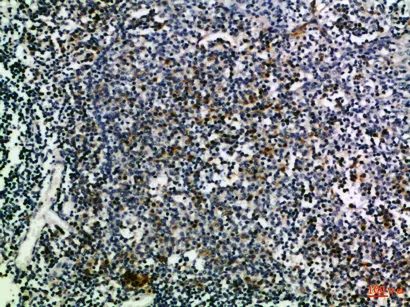
CD274 Rabbit Polyclonal Antibody
APRab08320-100μL · 100μL
Verified Partner
Sign in to see pricing and request a quote.
Brand Store Product
No external links. Get your quote directly here.

Description
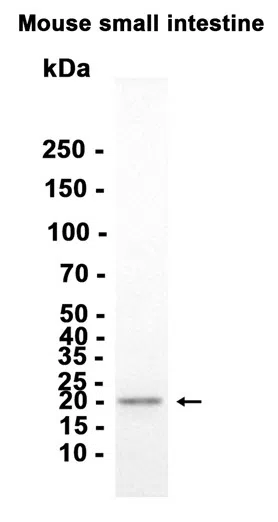
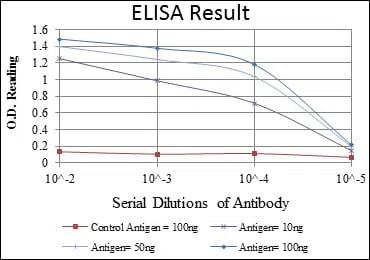
EnkiLife offers the CD274 Rabbit Polyclonal Antibody. This antibody reacts with Human,Rat,Mouse species and is suitable for IHC,ICC/IF,ELISA application. Alternative Names of Immunogen: Programmed cell death 1 ligand 1 (PD-L1) (PDCD1 ligand 1) (Programmed death ligand 1) (B7 homolog 1) (B7-H1) (CD antigen CD274). The product boasts remarkable high specificity, outstanding reproducibility, and exceptional affinity, making it a reliable and superior choice for your needs. Dilution Ratio: IHC 1:50-1:200,ICC/IF 1:100-1:300,ELISA 1:10000-1:20000 Background: This gene encodes an immune inhibitory receptor ligand that is expressed by hematopoietic and non-hematopoietic cells, such as T cells and B cells and various types of tumor cells. The encoded protein is a type I transmembrane protein that has immunoglobulin V-like and C-like domains. Interaction of this ligand with its receptor inhibits T-cell activation and cytokine production. During infection or inflammation of normal tissue, this interaction is important for preventing autoimmunity by maintaining homeostasis of the immune response. In tumor microenvironments, this interaction provides an immune escape for tumor cells through cytotoxic T-cell inactivation. Expression of this gene in tumor cells is considered to be prognostic in many types of human malignancies, including colon cancer and renal cell carcinoma. Alternative splicing results in multiple transcript variants. [provided by RefSeq, Sep 2015],function:Involved in the costimulatory signal, essential for T-cell proliferation and production of IL10 and IFNG, in an IL2-dependent and a PDCD1-independent manner. Interaction with PDCD1 inhibits T-cell proliferation and cytokine production.,induction:Up-regulated on T- and B-cells, dendritic cells, keratinocytes and monocytes after LPS and IFNG activation. Up-regulated in B-cells activated by surface Ig cross-linking.,similarity:Belongs to the immunoglobulin superfamily. BTN/MOG family.,similarity:Contains 1 Ig-like C2-type (immunoglobulin-like) domain.,similarity:Contains 1 Ig-like V-type (immunoglobulin-like) domain.,subunit:Interacts with PDCD1.,tissue specificity:Highly expressed in the heart, skeletal muscle, placenta and lung. Weakly expressed in the thymus, spleen, kidney and liver. Expressed on activated T- and B-cells, dendritic cells, keratinocytes and monocytes., Research Area: Cell adhesion molecules (CAMs);
More from EnkiLife