Phospho-EpoR (Tyr368) Rabbit Polyclonal Antibody
APRab04621-100μL · 100μL
Verified Partner
Sign in to see pricing and request a quote.
Brand Store Product
No external links. Get your quote directly here.

Description
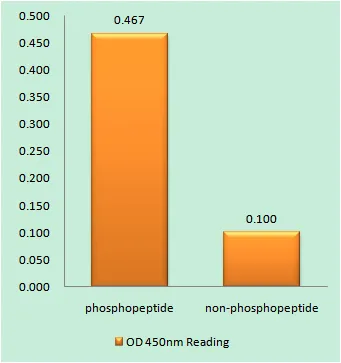
EnkiLife offers the Phospho-EpoR (Tyr368) Rabbit Polyclonal Antibody. This antibody reacts with Human,Mouse,Rat species and is suitable for WB,ICC/IF,ELISA application. Alternative Names of Immunogen: EPOR; Erythropoietin receptor; EPO-R. The product boasts remarkable high specificity, outstanding reproducibility, and exceptional affinity, making it a reliable and superior choice for your needs. Dilution Ratio: WB 1:500-1:2000,ICC/IF 1:200-1:1000,ELISA 1:5000-1:20000 Background: This gene encodes the erythropoietin receptor which is a member of the cytokine receptor family. Upon erythropoietin binding, this receptor activates Jak2 tyrosine kinase which activates different intracellular pathways including: Ras/MAP kinase, phosphatidylinositol 3-kinase and STAT transcription factors. The stimulated erythropoietin receptor appears to have a role in erythroid cell survival. Defects in the erythropoietin receptor may produce erythroleukemia and familial erythrocytosis. Dysregulation of this gene may affect the growth of certain tumors. Alternate splicing results in multiple transcript variants.[provided by RefSeq, May 2010],disease:Defects in EPOR are the cause of erythrocytosis familial type 1 (ECYT1) [MIM:133100]. ECYT1 is an autosomal dominant disorder characterized by increased serum red blood cell mass, elevated hemoglobin and hematocrit, hypersensitivity of erythroid progenitors to erythropoietin, erythropoietin low serum levels, and no increase in platelets nor leukocytes. It has a relatively benign course and does not progress to leukemia.,domain:Contains 1 copy of a cytoplasmic motif that is referred to as the immunoreceptor tyrosine-based inhibitor motif (ITIM). This motif is involved in modulation of cellular responses. The phosphorylated ITIM motif can bind the SH2 domain of several SH2-containing phosphatases.,domain:The box 1 motif is required for JAK interaction and/or activation.,domain:The WSXWS motif appears to be necessary for proper protein folding and thereby efficient intracellular transport and cell-surface receptor binding.,function:Isoform EPOR-T, missing the cytoplasmic tail, acts as a dominant-negative receptor of EPOR-mediated signaling.,function:Receptor for erythropoietin. Mediates erythropoietin-induced erythroblast proliferation and differentiation. Upon EPO stimulation, EPOR dimerizes triggering the JAK2/STAT5 signaling cascade. In some cell types, can also activate STAT1 and STAT3. May also activate the LYN tyrosine kinase.,PTM:On EPO stimulation, phosphorylated on C-terminal tyrosine residues by JAK2. The phosphotyrosine motifs are also recruitment sites for several SH2-containing proteins and adapter proteins which mediate cell proliferation. Phosphorylation on Tyr-454 is required for PTPN6 interaction, Tyr-426 for PTPN11. Tyr-426 is also required for SOCS3 binding, but Tyr-454/Tyr-456 motif is the preferred binding site.,PTM:Ubiquitinated by NOSIP; appears to be either multi-monoubiquitinated or polyubiquitinated. Ubiquitination mediates proliferation and survival of EPO-dependent cells.,similarity:Belongs to the type I cytokine receptor family. Type 1 subfamily.,similarity:Contains 1 fibronectin type-III domain.,similarity:Contains 1 Ras-GEF domain.,subcellular location:Secreted and located to the cell surface.,subunit:Forms homodimers on EPO stimulation. The tyrosine-phosphorylated form interacts with several SH2 domain-containing proteins including LYN (By similarity), the adapter protein APS, PTPN6 (By similarity), PTPN11, JAK2, PI3 kinases, STAT5A/B, SOCS3, CRKL (By similarity). Interacts with INPP5D/SHIP1 (By similarity). The N-terminal SH2 domain of PTPN6 binds Tyr-454 and inhibits signaling through dephosphorylation of JAK2 (By similarity). APS binding also inhibits the JAK-STAT signaling. Binding to PTPN11, preferentially through the N-terminal SH2 domain, promotes mitogenesis and phosphorylation of PTPN11 (By similarity). Binding of JAK2 (through its N-terminal) promotes cell-surface expression (By similarity). Interaction with the ubiquitin ligase NOSIP mediates EPO-induced cell proliferation. Interacts with ATXN2L.,tissue specificity:Erythroid cells and erythroid progenitor cells. Isoform EPOR-F is the most abundant form in EPO-dependent erythroleukemia cells and in late-stage erythroid progenitors. Isoform EPOR-S and isoform EPOR-T are the predominant forms in bone marrow. Isoform EPOR-T is the most abundant from in early-stage erythroid progenitor cells., Research Area: Cytokine-cytokine receptor interaction;Jak_STAT;Hematopoietic cell lineage;
More from EnkiLife