
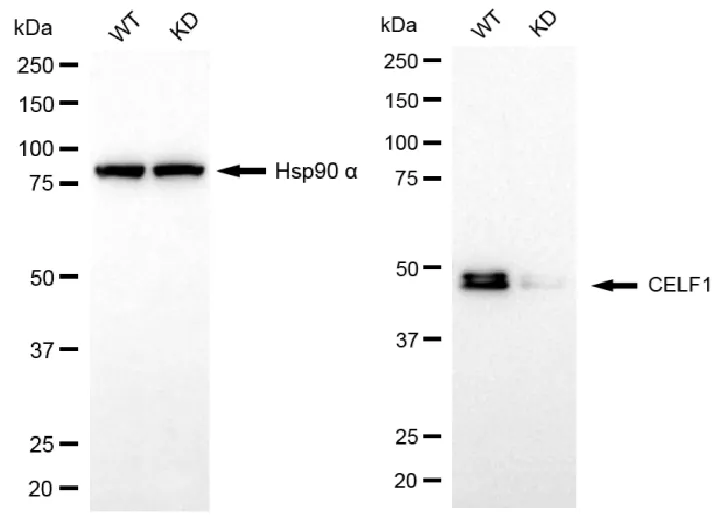
KD-Validated CUGBP Elav-Like Family Member 1 Recombinant Rabbit Monoclonal Antibody
KVAb01358-50ul · 50ul
Verified Partner
Sign in to see pricing and request a quote.
Brand Store Product
No external links. Get your quote directly here.

Description
EnkiLife offers the KD-Validated CUGBP Elav-Like Family Member 1 Recombinant Rabbit Monoclonal Antibody. This antibody reacts with Human,Mouse,Rat and is suitable for WB,FCM,ICC application. The product boasts remarkable high specificity, outstanding reproducibility, and exceptional affinity, making it a reliable and superior choice for your needs. Dilution Ratio: WB 1:1,000-1:5,000; FC 1:200-1:2,000; ICC 1:100-1:1,000 Alternative Names of Immunogen:CELF1; CUGBP Elav-Like Family Member 1; BRUNOL2; NAB50; CUGBP; EDEN-BP; CUG-BP; HNab50; CUGBP1; NAPOR; Embryo Deadenylation Element-Binding Protein Homolog; Nuclear Polyadenylated RNA-Binding Protein, 50-KD; 50 KDa Nuclear Polyadenylated RNA-Binding Protein; Embryo Deadenylation Element Binding Protein; CUG Triplet Repeat RNA-Binding Protein 1; CUG-BP- And ETR-3-Like Factor 1; RNA-Binding Protein BRUNOL-2; Deadenylation Factor CUG-BP; CUG RNA-Binding Protein; Bruno-Like Protein 2; EDEN-BP Homolog; Bruno-Like 2; CUG Triplet Repeat, RNA-Binding Protein 1; CUG Triplet Repeat, RNA Binding Protein 1; CUGBP, Elav-Like Family Member 1; CUG-BP1; CELF-1 Background: Members of the CELF/BRUNOL protein family contain two N-terminal RNA recognition motif (RRM) domains, one C-terminal RRM domain, and a divergent segment of 160-230 aa between the second and third RRM domains. Members of this protein family regulate pre-mRNA alternative splicing and may also be involved in mRNA editing, and translation. This gene may play a role in myotonic dystrophy type 1 (DM1) via interactions with the dystrophia myotonica-protein kinase (DMPK) gene. Alternative splicing results in multiple transcript variants encoding different isoforms. [provided by RefSeq, Jul 2008] Research Area: Epigenetics and Nuclear Signaling