
KD-Validated DDB1 Recombinant Rabbit Monoclonal Antibody
KVAb01730-100ul · 100ul
Verified Partner
Sign in to see pricing and request a quote.
Brand Store Product
No external links. Get your quote directly here.
Description
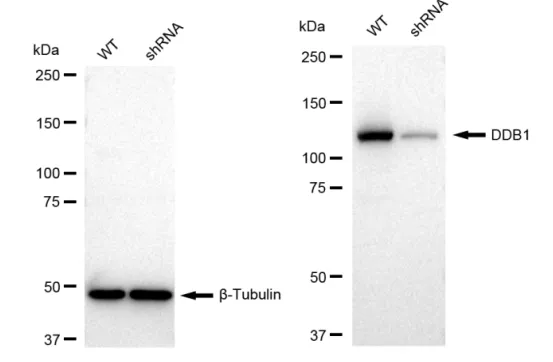
EnkiLife offers the KD-Validated DDB1 Recombinant Rabbit Monoclonal Antibody. This antibody reacts with Human,Mouse,Rat and is suitable for WB,FCM,ICC application. The product boasts remarkable high specificity, outstanding reproducibility, and exceptional affinity, making it a reliable and superior choice for your needs. Dilution Ratio: WB 1:10,000-1:50,000; FC 1:200-1:2,000; ICC 1:100-1:1,000 Alternative Names of Immunogen:DDB1; Damage Specific DNA Binding Protein 1; Xeroderma Pigmentosum Group E-Complementing Protein ; UV-Damaged DNA-Binding Protein 1; UV-Damaged DNA-Binding Factor; DNA Damage-Binding Protein 1; DNA Damage-Binding Protein A; HBV X-Associated Protein 1; XPE-Binding Factor; DDB P127 Subunit; UV-DDB 1; XPE-BF; XAP-1; XAP1; Damage-Specific DNA Binding Protein 1 (127kD); Damage-Specific DNA Binding Protein 1, 127kDa; Damage-Specific DNA-Binding Protein 1; UV-DDB1; WHIKERS; DDBA; XPCE; DDBa; XPCe; XPE Background: The protein encoded by this gene is the large subunit (p127) of the heterodimeric DNA damage-binding (DDB) complex while another protein (p48) forms the small subunit. This protein complex functions in nucleotide-excision repair and binds to DNA following UV damage. Defective activity of this complex causes the repair defect in patients with xeroderma pigmentosum complementation group E (XPE) - an autosomal recessive disorder characterized by photosensitivity and early onset of carcinomas. However, it remains for mutation analysis to demonstrate whether the defect in XPE patients is in this gene or the gene encoding the small subunit. In addition, Best vitelliform mascular dystrophy is mapped to the same region as this gene on 11q, but no sequence alternations of this gene are demonstrated in Best disease patients. The protein encoded by this gene also functions as an adaptor molecule for the cullin 4 (CUL4) ubiquitin E3 ligase complex by facilitating the binding of substrates to this complex and the ubiquitination of proteins. [provided by RefSeq, May 2012] Research Area: Epigenetics and Nuclear Signaling
More from EnkiLife







