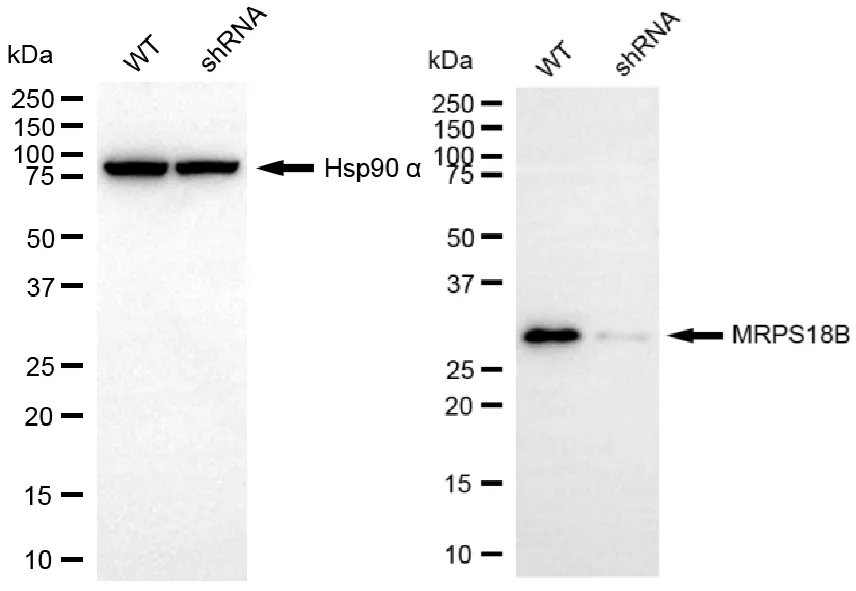
KD-Validated MRPS18B Recombinant Rabbit Monoclonal Antibody
KVAb00309-100ul · 100ul
Verified Partner
Sign in to see pricing and request a quote.
Brand Store Product
No external links. Get your quote directly here.
Description
EnkiLife offers the KD-Validated MRPS18B Recombinant Rabbit Monoclonal Antibody. This antibody reacts with Human,Mouse,Rat and is suitable for WB,FCM application. The product boasts remarkable high specificity, outstanding reproducibility, and exceptional affinity, making it a reliable and superior choice for your needs. Dilution Ratio: WB 1:1,000-1:5,000; FC 1:200-1:2,000 Alternative Names of Immunogen:MRPS18B; Mitochondrial Ribosomal Protein S18B; C6orf14; MRPS18-2; HSPC183; PTD017; MS40; 28S Ribosomal Protein S18-2, Mitochondrial; 28S Ribosomal Protein S18b, Mitochondrial; Small Ribosomal Subunit Protein BS18b; Small Ribosomal Subunit Protein MS40; MRP-S18-2; MRP-S18-B; Mrps18-B; S18mt-B; Mitochondrial Small Ribosomal Subunit Protein BS18m-B; Mitochondrial Small Ribosomal Subunit Protein BS18b; Mitochondrial Small Ribosomal Subunit Protein MS40; Mitochondrial Ribosomal Protein S18-2; HumanS18a; S18amt Background: Mammalian mitochondrial ribosomal proteins are encoded by nuclear genes and help in protein synthesis within the mitochondrion. Mitochondrial ribosomes (mitoribosomes) consist of a small 28S subunit and a large 39S subunit. They have an estimated 75% protein to rRNA composition compared to prokaryotic ribosomes, where this ratio is reversed. Another difference between mammalian mitoribosomes and prokaryotic ribosomes is that the latter contain a 5S rRNA. Among different species, the proteins comprising the mitoribosome differ greatly in sequence, and sometimes in biochemical properties, which prevents easy recognition by sequence homology. This gene encodes a 28S subunit protein that belongs to the ribosomal protein S18P family. The encoded protein is one of three that has significant sequence similarity to bacterial S18 proteins. The primary sequences of the three human mitochondrial S18 proteins are no more closely related to each other than they are to the prokaryotic S18 proteins. Pseudogenes corresponding to this gene are found on chromosomes 1q and 2q. [provided by RefSeq, Jul 2008] Research Area: Epigenetics and Nuclear Signaling
More from EnkiLife