
KD-Validated MUC1 Recombinant Rabbit Monoclonal Antibody
KVAb01534-50ul · 50ul
Verified Partner
Sign in to see pricing and request a quote.
Brand Store Product
No external links. Get your quote directly here.

Description
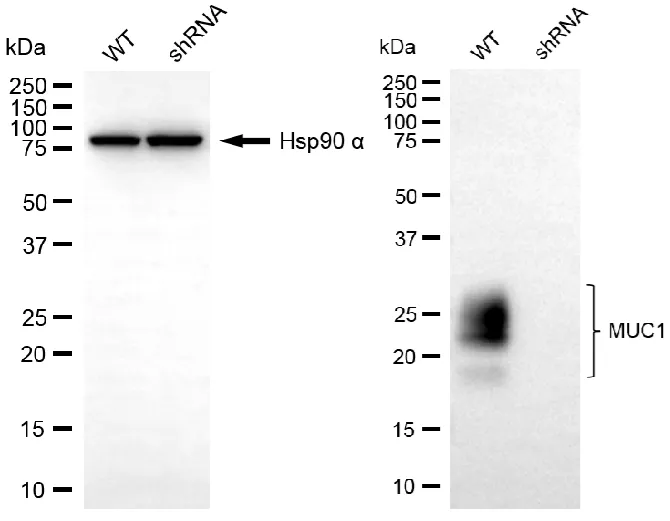
EnkiLife offers the KD-Validated MUC1 Recombinant Rabbit Monoclonal Antibody. This antibody reacts with Human and is suitable for WB,FCM,ICC application. The product boasts remarkable high specificity, outstanding reproducibility, and exceptional affinity, making it a reliable and superior choice for your needs. Dilution Ratio: WB 1:1,000-1:5,000; FC 1:200-1:2,000; ICC 1:100-1:1,000 Alternative Names of Immunogen:MUC1; Mucin 1, Cell Surface Associated; KL-6; PEM; EMA; ADMCKD1; ADMCKD; Ca15-3; CD227; MCKD; MCD; PUM; Tumor-Associated Epithelial Membrane Antigen; Breast Carcinoma-Associated Antigen DF3; Peanut-Reactive Urinary Mucin; Polymorphic Epithelial Mucin; Carcinoma-Associated Mucin; Mucin 1, Transmembrane; Krebs Von Den Lungen-6; Cancer Antigen 15-3; Episialin; CA 15-3; Mucin-1; H23AG; MCKD1; MUC-1; PEMT; Medullary Cystic Kidney Disease 1 (Autosomal Dominant); Tumor Associated Epithelial Mucin; Epithelial Membrane Antigen; Tumor-Associated Mucin; CD227 Antigen; H23 Antigen; MUC-1/SEC; MUC-1/X; MUC1/ZD; ADTKD2; MAM6 Background: This gene encodes a membrane-bound protein that is a member of the mucin family. Mucins are O-glycosylated proteins that play an essential role in forming protective mucous barriers on epithelial surfaces. These proteins also play a role in intracellular signaling. This protein is expressed on the apical surface of epithelial cells that line the mucosal surfaces of many different tissues including lung, breast stomach and pancreas. This protein is proteolytically cleaved into alpha and beta subunits that form a heterodimeric complex. The N-terminal alpha subunit functions in cell-adhesion and the C-terminal beta subunit is involved in cell signaling. Overexpression, aberrant intracellular localization, and changes in glycosylation of this protein have been associated with carcinomas. This gene is known to contain a highly polymorphic variable number tandem repeats (VNTR) domain. Alternate splicing results in multiple transcript variants.[provided by RefSeq, Feb 2011] Research Area: Tags & Cell Markers,Signal Transduction,Cancer
More from EnkiLife







