
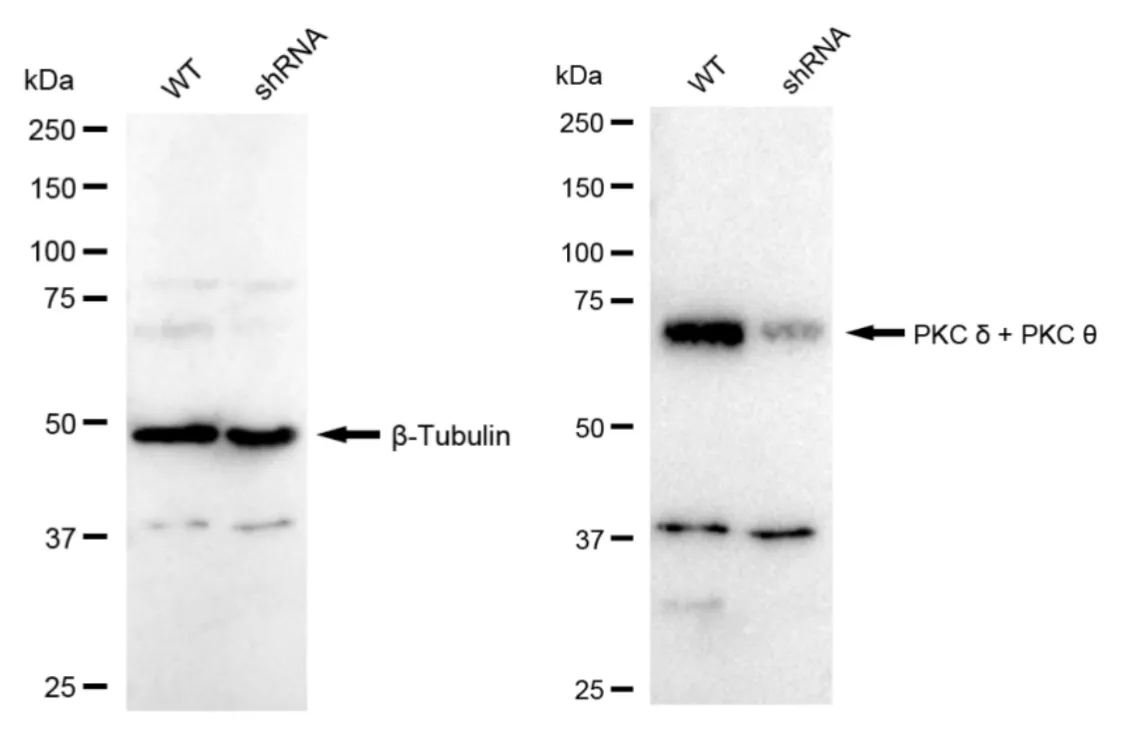
KD-Validated PKC Delta + PKC Theta Recombinant Rabbit Monoclonal Antibody
KVAb01211-100ul · 100ul
Verified Partner
Sign in to see pricing and request a quote.
Brand Store Product
No external links. Get your quote directly here.

Description
EnkiLife offers the KD-Validated PKC Delta + PKC Theta Recombinant Rabbit Monoclonal Antibody. This antibody reacts with Human,Mouse,Rat and is suitable for WB,FCM,ICC application. The product boasts remarkable high specificity, outstanding reproducibility, and exceptional affinity, making it a reliable and superior choice for your needs. Dilution Ratio: WB 1:1,000-1:5,000; FC 1:200-1:2,000; ICC 1:100-1:1,000 Alternative Names of Immunogen:PRKCD; Protein Kinase C Delta; Tyrosine-Protein Kinase PRKCD; Protein Kinase C Delta Type; EC 2.7.11.13; NPKC-Delta; PKCD; Protein Kinase C Delta VIII; Protein Kinase C, Delta; EC 2.7.10.2; EC 2.7.11; ALPS3; CVID9; MAY1; PRKCQ; Protein Kinase C Theta; Protein Kinase C Theta Type; EC 2.7.11.13; NPKC-Theta; PRKCT; Protein Kinase C, Theta; EC 2.7.11 Background: PRKCD: The protein encoded by this gene is a member of the protein kinase C family of serine- and threonine-specific protein kinases. The encoded protein is activated by diacylglycerol and is both a tumor suppressor and a positive regulator of cell cycle progression. Also, this protein can positively or negatively regulate apoptosis. Defects in this gene are a cause of autoimmune lymphoproliferative syndrome. [provided by RefSeq, Aug 2017] PRKCQ: Protein kinase C (PKC) is a family of serine- and threonine-specific protein kinases that can be activated by calcium and the second messenger diacylglycerol. PKC family members phosphorylate a wide variety of protein targets and are known to be involved in diverse cellular signaling pathways. PKC family members also serve as major receptors for phorbol esters, a class of tumor promoters. Each member of the PKC family has a specific expression profile and is believed to play a distinct role. The protein encoded by this gene is one of the PKC family members. It is a calcium-independent and phospholipid-dependent protein kinase. This kinase is important for T-cell activation. It is required for the activation of the transcription factors NF-kappaB and AP-1, and may link the T cell receptor (TCR) signaling complex to the activation of the transcription factors. [provided by RefSeq, Jul 2008] Research Area: Signal Transduction,Neuroscience,Cancer
More from EnkiLife







