
KD-Validated Proteasome 20S Subunit Beta 10 Recombinant Rabbit Monoclonal Antibody
KVAb00016-100ul · 100ul
Verified Partner
Sign in to see pricing and request a quote.
Brand Store Product
No external links. Get your quote directly here.
Description
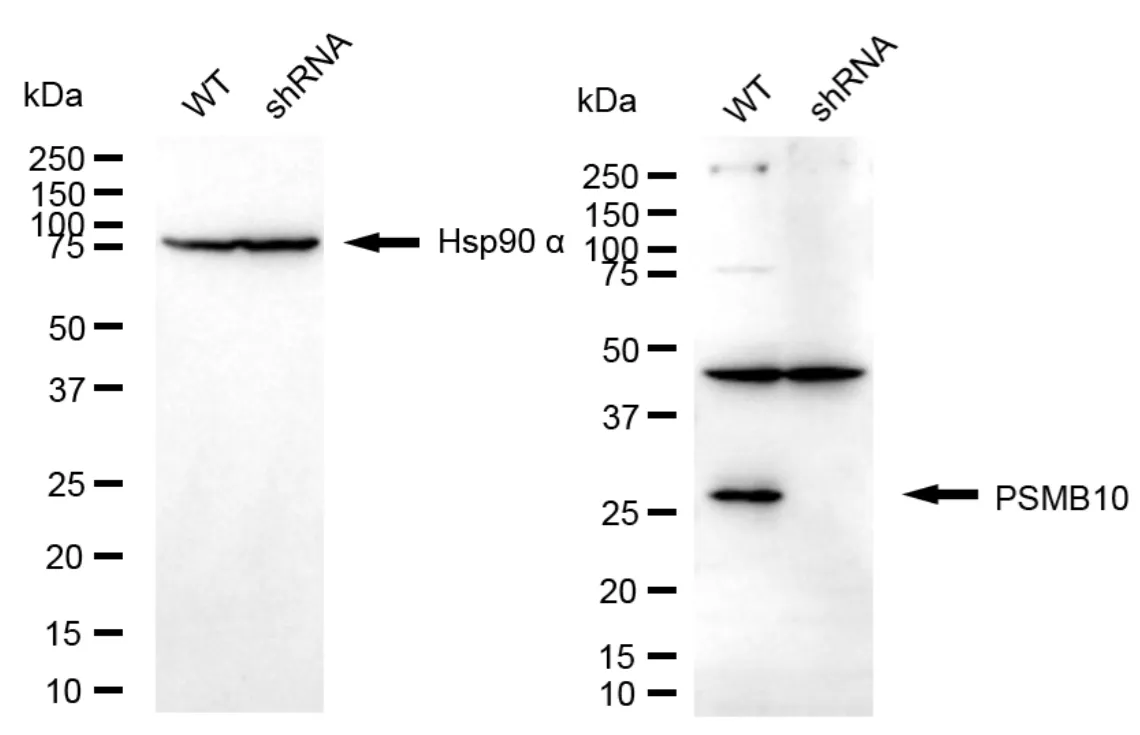
EnkiLife offers the KD-Validated Proteasome 20S Subunit Beta 10 Recombinant Rabbit Monoclonal Antibody. This antibody reacts with Human,Mouse,Rat and is suitable for WB,FCM application. The product boasts remarkable high specificity, outstanding reproducibility, and exceptional affinity, making it a reliable and superior choice for your needs. Dilution Ratio: WB 1:1,000-1:5,000; FC 1:200-1:2,000 Alternative Names of Immunogen:PSMB10; Proteasome 20S Subunit Beta 10; LMP10; MECL1; Proteasome (Prosome, Macropain) Subunit, Beta Type, 10; Multicatalytic Endopeptidase Complex Subunit MECl-1; Proteasome Subunit Beta Type-10; Low Molecular Mass Protein 10; Proteasome Subunit Beta 10; Proteasome Subunit Beta-2i; Macropain Subunit MECl-1; Proteasome MECl-1; EC 3.4.25.1; MGC1665; Beta2i; Proteasome Catalytic Subunit 2i; Proteasome Subunit Beta 7i; Proteasome Subunit Beta2i; Proteasome Subunit MECL1; Proteasome Subunit Β2i; PRAAS5; BETA2I Background: The proteasome is a multicatalytic proteinase complex with a highly ordered ring-shaped 20S core structure. The core structure is composed of 4 rings of 28 non-identical subunits; 2 rings are composed of 7 alpha subunits and 2 rings are composed of 7 beta subunits. Proteasomes are distributed throughout eukaryotic cells at a high concentration and cleave peptides in an ATP/ubiquitin-dependent process in a non-lysosomal pathway. An essential function of a modified proteasome, the immunoproteasome, is the processing of class I MHC peptides. This gene encodes a member of the proteasome B-type family, also known as the T1B family, that is a 20S core beta subunit. Proteolytic processing is required to generate a mature subunit. Expression of this gene is induced by gamma interferon, and this gene product replaces catalytic subunit 2 (proteasome beta 7 subunit) in the immunoproteasome. [provided by RefSeq, Jul 2008] Research Area: Immunology,Cell Biology
More from EnkiLife







