
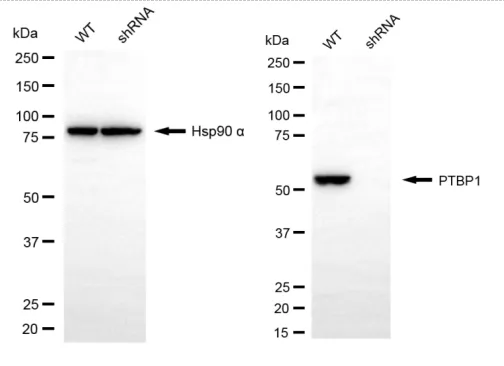
KD-Validated PTBP1 Recombinant Rabbit Monoclonal Antibody
KVAb00948-50ul · 50ul
Verified Partner
Sign in to see pricing and request a quote.
Brand Store Product
No external links. Get your quote directly here.

Description
EnkiLife offers the KD-Validated PTBP1 Recombinant Rabbit Monoclonal Antibody. This antibody reacts with Human,Mouse,Rat and is suitable for WB,FCM,ICC,IHC-P application. The product boasts remarkable high specificity, outstanding reproducibility, and exceptional affinity, making it a reliable and superior choice for your needs. Dilution Ratio: WB 1:1,000-1:5,000; FC 1:200-1:2,000; ICC 1:100-1:1,000; IHC-P 1:100-1:200 Alternative Names of Immunogen:Polypyrimidine Tract Binding Protein 1; Heterogeneous Nuclear Ribonucleoprotein I; HNRNP-I; HNRPI; PTB-1; PTB2; PTB3; PTB4; PPTB; PTB; Polypyrimidine Tract Binding Protein (Heterogeneous Nuclear Ribonucleoprotein I); Polypyrimidine Tract-Binding Protein 1; 57 KDa RNA-Binding Protein PPTB-1; HnRNP I; Heterogeneous Nuclear Ribonucleoprotein Polypeptide I; RNA-Binding Protein; HNRNPI; PTB-T Background: This gene belongs to the subfamily of ubiquitously expressed heterogeneous nuclear ribonucleoproteins (hnRNPs). The hnRNPs are RNA-binding proteins and they complex with heterogeneous nuclear RNA (hnRNA). These proteins are associated with pre-mRNAs in the nucleus and appear to influence pre-mRNA processing and other aspects of mRNA metabolism and transport. While all of the hnRNPs are present in the nucleus, some seem to shuttle between the nucleus and the cytoplasm. The hnRNP proteins have distinct nucleic acid binding properties. The protein encoded by this gene has four repeats of quasi-RNA recognition motif (RRM) domains that bind RNAs. This protein binds to the intronic polypyrimidine tracts that requires pre-mRNA splicing and acts via the protein degradation ubiquitin-proteasome pathway. It may also promote the binding of U2 snRNP to pre-mRNAs. This protein is localized in the nucleoplasm and it is also detected in the perinucleolar structure. Alternatively spliced transcript variants encoding different isoforms have been described. [provided by RefSeq, Jul 2008] Research Area: Epigenetics and Nuclear Signaling