
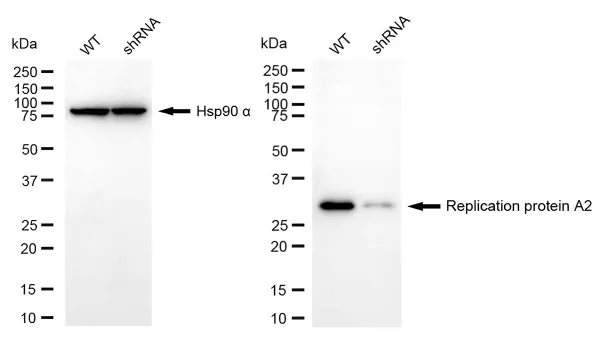
KD-Validated RPA2 Recombinant Rabbit Monoclonal Antibody
KVAb01842-20ul · 20ul
Verified Partner
Sign in to see pricing and request a quote.
Brand Store Product
No external links. Get your quote directly here.

Description
EnkiLife offers the KD-Validated RPA2 Recombinant Rabbit Monoclonal Antibody. This antibody reacts with Human,Rat and is suitable for WB application. The product boasts remarkable high specificity, outstanding reproducibility, and exceptional affinity, making it a reliable and superior choice for your needs. Dilution Ratio: WB 1:1,000-1:5,000 Alternative Names of Immunogen:RPA2; Replication Protein A2; Replication Protein A 32 KDa Subunit; Replication Protein A 34 KDa Subunit; Replication Factor A Protein 2; RF-A Protein 2; RP-A P32; RP-A P34; REPA2; RPA32; Replication Protein A2 (32kD); Replication Protein A2, 32kDa; RPA34 Background: This gene encodes a subunit of the heterotrimeric Replication Protein A (RPA) complex, which binds to single-stranded DNA (ssDNA), forming a nucleoprotein complex that plays an important role in DNA metabolism, being involved in DNA replication, repair, recombination, telomere maintenance, and co-ordinating the cellular response to DNA damage through activation of the ataxia telangiectasia and Rad3-related protein (ATR) kinase. The RPA complex protects single-stranded DNA from nucleases, prevents formation of secondary structures that would interfere with repair, and co-ordinates the recruitment and departure of different genome maintenance factors. The heterotrimeric complex has two different modes of ssDNA binding, a low-affinity and high-affinity mode, determined by which oligonucleotide/oligosaccharide-binding (OB) domains of the complex are utilized, and differing in the length of DNA bound. This subunit contains a single OB domain that participates in high-affinity DNA binding and also contains a winged helix domain at its carboxy terminus, which interacts with many genome maintenance protein. Post-translational modifications of the RPA complex also plays a role in co-ordinating different damage response pathways. [provided by RefSeq, Sep 2017] Research Area: Epigenetics and Nuclear Signaling
More from EnkiLife







