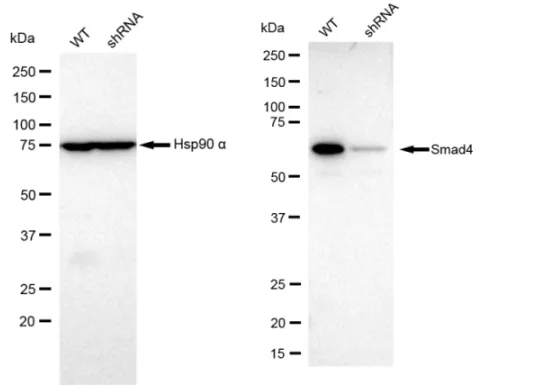
KD-Validated Smad4 Recombinant Rabbit Monoclonal Antibody
KVAb00253-20ul · 20ul
Verified Partner
Sign in to see pricing and request a quote.
Brand Store Product
No external links. Get your quote directly here.

Description
EnkiLife offers the KD-Validated Smad4 Recombinant Rabbit Monoclonal Antibody. This antibody reacts with Human,Mouse,Rat and is suitable for WB,FCM,ICC,IHC-P application. The product boasts remarkable high specificity, outstanding reproducibility, and exceptional affinity, making it a reliable and superior choice for your needs. Dilution Ratio: WB 1:1,000-1:5,000; FC 1:200-1:2,000; ICC 1:100-1:1,000; IHC-P 1:100-1:200 Alternative Names of Immunogen:DPC4; MADH4; Mothers Against Decapentaplegic Homolog 4; Deletion Target In Pancreatic Carcinoma 4; MAD Homolog 4; MAD, Mothers Against Decapentaplegic Homolog 4 (Drosophila); Mothers Against Decapentaplegic, Drosophila, Homolog Of, 4; SMAD, Mothers Against DPP Homolog 4 (Drosophila); Deleted In Pancreatic Carcinoma Locus 4; SMAD, Mothers Against DPP Homolog 4; Mothers Against DPP Homolog 4; SMAD 4; HSMAD4; MYHRS; Smad4; JIP Background: This gene encodes a member of the Smad family of signal transduction proteins. Smad proteins are phosphorylated and activated by transmembrane serine-threonine receptor kinases in response to transforming growth factor (TGF)-beta signaling. The product of this gene forms homomeric complexes and heteromeric complexes with other activated Smad proteins, which then accumulate in the nucleus and regulate the transcription of target genes. This protein binds to DNA and recognizes an 8-bp palindromic sequence (GTCTAGAC) called the Smad-binding element (SBE). The protein acts as a tumor suppressor and inhibits epithelial cell proliferation. It may also have an inhibitory effect on tumors by reducing angiogenesis and increasing blood vessel hyperpermeability. The encoded protein is a crucial component of the bone morphogenetic protein signaling pathway. The Smad proteins are subject to complex regulation by post-translational modifications. Mutations or deletions in this gene have been shown to result in pancreatic cancer, juvenile polyposis syndrome, and hereditary hemorrhagic telangiectasia syndrome. [provided by RefSeq, May 2022] Research Area: Signal Transduction,Epigenetics and Nuclear Signaling,Stem Cells,Cancer,Cardiovascular,Cancer,Metabolism
More from EnkiLife