
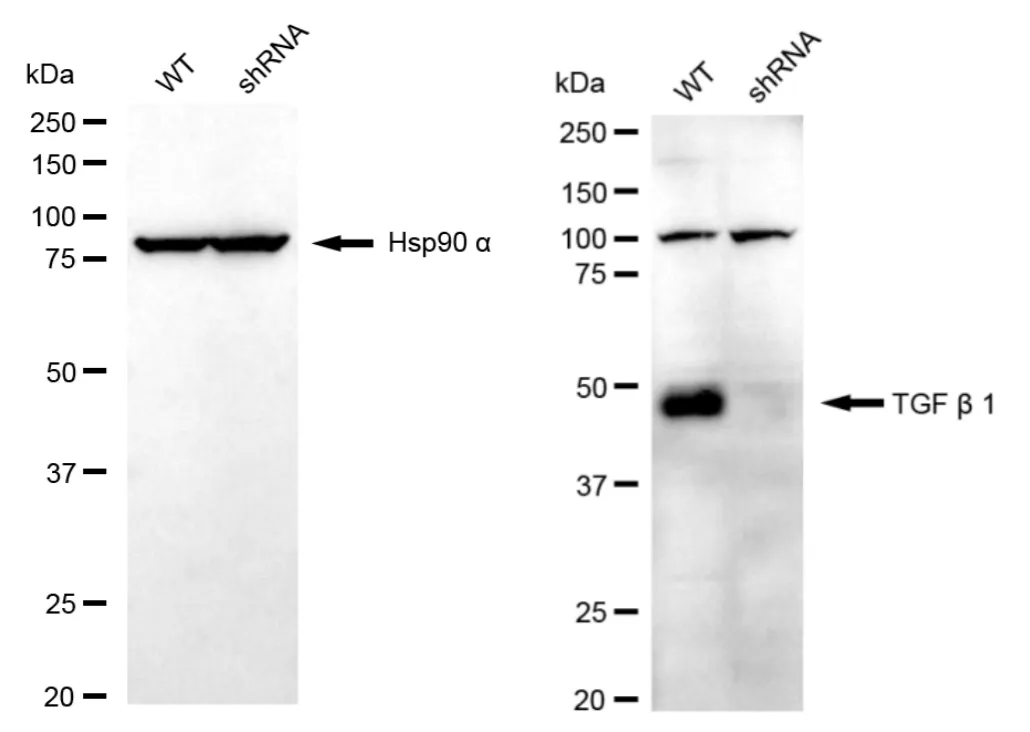
KD-Validated TGF Beta 1 Recombinant Rabbit Monoclonal Antibody
KVAb01158-50ul · 50ul
Verified Partner
Sign in to see pricing and request a quote.
Brand Store Product
No external links. Get your quote directly here.
Description
EnkiLife offers the KD-Validated TGF Beta 1 Recombinant Rabbit Monoclonal Antibody. This antibody reacts with Human,Mouse,Rat and is suitable for WB,FCM,ICC application. The product boasts remarkable high specificity, outstanding reproducibility, and exceptional affinity, making it a reliable and superior choice for your needs. Dilution Ratio: WB 1:1,000-1:5,000; FC 1:200-1:2,000; ICC 1:100-1:1,000 Alternative Names of Immunogen:TGFB1; Transforming Growth Factor Beta 1; TGFB; CED; Transforming Growth Factor Beta-1 Proprotein; Prepro-Transforming Growth Factor Beta-1; TGFbeta; DPD1; Diaphyseal Dysplasia 1, Progressive; Transforming Growth Factor, Beta 1; Transforming Growth Factor Beta 1; Camurati-Engelmann Disease; Latency-Associated Peptide; TGF-Beta-1; TGF-Beta1; IBDIMDE; TGFBETA; LAP Background: This gene encodes a secreted ligand of the TGF-beta (transforming growth factor-beta) superfamily of proteins. Ligands of this family bind various TGF-beta receptors leading to recruitment and activation of SMAD family transcription factors that regulate gene expression. The encoded preproprotein is proteolytically processed to generate a latency-associated peptide (LAP) and a mature peptide, and is found in either a latent form composed of a mature peptide homodimer, a LAP homodimer, and a latent TGF-beta binding protein, or in an active form consisting solely of the mature peptide homodimer. The mature peptide may also form heterodimers with other TGFB family members. This encoded protein regulates cell proliferation, differentiation and growth, and can modulate expression and activation of other growth factors including interferon gamma and tumor necrosis factor alpha. This gene is frequently upregulated in tumor cells, and mutations in this gene result in Camurati-Engelmann disease. [provided by RefSeq, Aug 2016] Research Area: Cardiovascular,Signal Transduction,Stem Cells,Cancer,Metabolism
More from EnkiLife







