KO-Validated PTEN Recombinant Rabbit Monoclonal Antibody
KVAb00136-20ul · 20ul
Verified Partner
Sign in to see pricing and request a quote.
Brand Store Product
No external links. Get your quote directly here.
Description
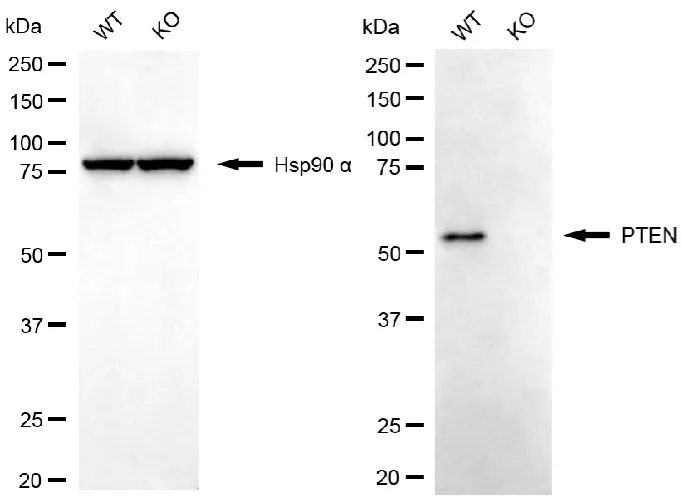
EnkiLife offers the KO-Validated PTEN Recombinant Rabbit Monoclonal Antibody. This antibody reacts with Human,Mouse,Rat and is suitable for WB,FCM,ICC application. The product boasts remarkable high specificity, outstanding reproducibility, and exceptional affinity, making it a reliable and superior choice for your needs. Dilution Ratio: WB 1:1,000-1:5,000; FC 1:200-1:2,000; ICC 1:100-1:1,000 Alternative Names of Immunogen:PTEN; Phosphatase And Tensin Homolog; MMAC1; TEP1; Mutated In Multiple Advanced Cancers 1; PTEN1; Phosphatidylinositol 3,4,5-Trisphosphate 3-Phosphatase And Dual-Specificity Protein Phosphatase PTEN; MHAM; BZS; Phosphatidylinositol-3,4,5-Trisphosphate 3-Phosphatase And Dual-Specificity Protein Phosphatase PTEN; MMAC1 Phosphatase And Tensin Homolog Deleted On Chromosome 10; Mitochondrial Phosphatase And Tensin Protein Alpha; Phosphatase And Tensin-Like Protein; PTEN Variant PTEN-R234Afs*11; Protein Tyrosine Phosphatase; PTEN Variant PTEN-K267Rfs*9; PTEN Variant PTEN-L247*; Mitochondrial PTENalpha; PTENepsilon; EC 3.1.3.16; EC 3.1.3.48; EC 3.1.3.67; 10q23del; PTENbeta; CWS1; GLM2; DEC; Background: This gene was identified as a tumor suppressor that is mutated in a large number of cancers at high frequency. The protein encoded by this gene is a phosphatidylinositol-3,4,5-trisphosphate 3-phosphatase. It contains a tensin like domain as well as a catalytic domain similar to that of the dual specificity protein tyrosine phosphatases. Unlike most of the protein tyrosine phosphatases, this protein preferentially dephosphorylates phosphoinositide substrates. It negatively regulates intracellular levels of phosphatidylinositol-3,4,5-trisphosphate in cells and functions as a tumor suppressor by negatively regulating AKT/PKB signaling pathway. The use of a non-canonical (CUG) upstream initiation site produces a longer isoform that initiates translation with a leucine, and is thought to be preferentially associated with the mitochondrial inner membrane. This longer isoform may help regulate energy metabolism in the mitochondria. A pseudogene of this gene is found on chromosome 9. Alternative splicing and the use of multiple translation start codons results in multiple transcript variants encoding different isoforms. [provided by RefSeq, Feb 2015] Research Area: Cell Biology,Signal Transduction,Epigenetics and Nuclear Signaling,Cancer,Metabolism,Neuroscience
More from EnkiLife