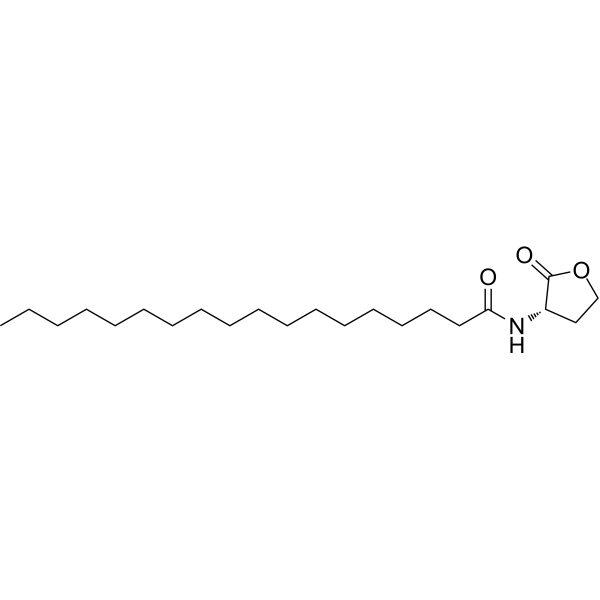
N-Octadecanoyl-L-homoserine lactone
HY-W127487 · 10 mg
MedChemExpress · Cat: HY-W127487
Reach 3+ verified distributors
Manufacturer product page
medchemexpress.com/n-octadecanoyl-l-homoserine-lactone.html...Description
Quorum sensing is a regulatory system used by bacteria to control gene expression in response to increased cell density. This regulatory process manifests itself in a variety of phenotypes, including biofilm formation and virulence factor production. Coordinated gene expression is achieved through the production, release and detection of small diffusible signaling molecules called autoinducers. N-acylated homoserine lactones AHLs comprise a class of such autoinducers, each of which generally consists of a fatty acid coupled to a homoserine lactone HSL . Modulation of bacterial quorum-sensing signaling systems to suppress pathogenesis represents a new approach to antimicrobial research for infectious diseases. AHLs differ in acyl length C4-C18 , C3 substitution hydrogen, hydroxyl, or oxo group , and the presence or absence of one or more carbon-carbon double bonds in the fatty acid chain. These differences confer signaling specificity through the affinity of the LuxR family of transcriptional regulators. C18-HSL, one of four lipophilic long acyl side chain AHLs produced by the LuxI AHL synthase homolog SinI, is involved in quorum-sensing signaling in strains of Rhizobium meliloti a nitrogen-fixing bacterial symbiont of the legume M. sativa . C18-HSL and other hydrophobic AHLs tend to localize in the relatively lipophilic environment of bacterial cells and cannot diffuse freely across the cell membrane. Long-chain N-acyl homoserine lactones can be exported from cells by efflux pumps, or can be transported between communicating cells by extracellular outer membrane vesicles.
More from MedChemExpress