Phospho-Nibrin (Ser278) Rabbit Polyclonal Antibody
APRab05109-20μL · 20μL
Verified Partner
Sign in to see pricing and request a quote.
Brand Store Product
No external links. Get your quote directly here.

Description
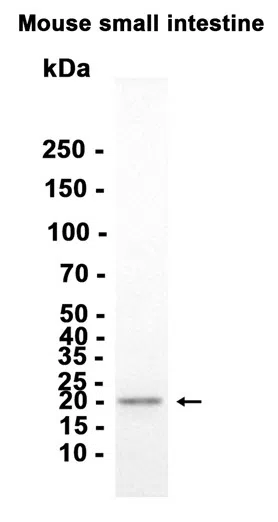
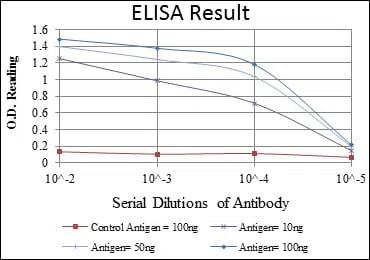
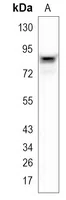
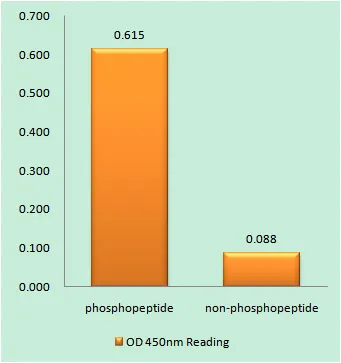
EnkiLife offers the Phospho-Nibrin (Ser278) Rabbit Polyclonal Antibody. This antibody reacts with Human,Rat,Mouse species and is suitable for WB,ICC/IF,ELISA application. Alternative Names of Immunogen: NBN; NBS; NBS1; P95; Nibrin; Cell cycle regulatory protein p95; Nijmegen breakage syndrome protein 1. The product boasts remarkable high specificity, outstanding reproducibility, and exceptional affinity, making it a reliable and superior choice for your needs. Dilution Ratio: WB 1:500-1:2000,ICC/IF 1:200-1:1000,ELISA 1:5000-1:20000 Background: Mutations in this gene are associated with Nijmegen breakage syndrome, an autosomal recessive chromosomal instability syndrome characterized by microcephaly, growth retardation, immunodeficiency, and cancer predisposition. The encoded protein is a member of the MRE11/RAD50 double-strand break repair complex which consists of 5 proteins. This gene product is thought to be involved in DNA double-strand break repair and DNA damage-induced checkpoint activation. [provided by RefSeq, Jul 2008],disease:Defects in NBN are a cause of genetic susceptibility to breast cancer (BC) [MIM:114480]. BC is an extremely common malignancy, affecting one in eight women during their lifetime. A positive family history has been identified as major contributor to risk of development of the disease, and this link is striking for early-onset breast cancer.,disease:Defects in NBN are the cause of Nijmegen breakage syndrome (NBS) [MIM:251260]. NBS is an autosomal recessive syndrome characterized by chromosomal instability, radiation sensitivity, microcephaly, growth retardation, immunodeficiency and predisposition to cancer, particularly to lymphoid malignancies.,disease:Defects in NBN may be associated with aplastic anemia [MIM:609135]. Aplastic anemia is a disease of bone-marrow failure characterized by peripheral pancytopenia and marrow hypoplasia. Most of the cases of aplastic anemia are idiopathic, some are familial and some are due to a viral infection or to exposure to chemicals and radiation.,disease:Defects in NBN might play a role in the pathogenesis of childhood acute lymphoblastic leukemia (ALL).,domain:The C-terminal domain contains a MRE11-binding site, and this interaction is required for the nuclear localization of the MRN complex.,domain:The EEXXXDDL motif at the C-terminus is required for the interaction with ATM and its recruitment to sites of DNA damage and promote the phosphorylation of ATM substrates, leading to the events of DNA damage response.,domain:The FHA and BRCT domains are likely to have a crucial role for both binding to histone H2AFX and for relocalization of MRE11/RAD50 complex to the vicinity of DNA damage.,function:Component of the MRE11/RAD50/NBN (MRN complex) which plays a critical role in the cellular response to DNA damage and the maintenance of chromosome integrity. The complex is involved in double-strand break (DSB) repair, DNA recombination, maintenance of telomere integrity, cell cycle checkpoint control and meiosis. The complex possesses single-strand endonuclease activity and double-strand-specific 3'-5' exonuclease activity, which are provided by MRE11A. RAD50 may be required to bind DNA ends and hold them in close proximity. NBN modulate the DNA damage signal sensing by recruiting PI3/PI4-kinase family members ATM, ATR, and probably DNA-PKcs to the DNA damage sites and activating their functions. It can also recruit MRE11 and RAD50 to the proximity of DSBs by an interaction with the histone H2AX. NBN also functions in telomere length maintenance by generating the 3' overhang which serves as a primer for telomerase dependent telomere elongation. NBN is a major player in the control of intra-S-phase checkpoint and there is some evidence that NBN is involved in G1 and G2 checkpoints. The roles of NBS1/MRN encompass DNA damage sensor, signal transducer, and effector, which enable cells to maintain DNA integrity and genomic stability.,miscellaneous:In case of infection by adenovirus E4, the MRN complex is inactivated and degraded by viral oncoproteins, thereby preventing concatenation of viral genomes in infected cells.,PTM:Phosphorylated by ATM in response of ionizing radiation, and such phosphorylation is responsible intra-S phase checkpoint control and telomere maintenance.,sequence caution:Contaminating sequence. Potential poly-A sequence starting in position 550.,similarity:Contains 1 BRCT domain.,similarity:Contains 1 FHA domain.,subcellular location:Localizes to discrete nuclear foci after treatment with genotoxic agents.,subunit:Component of the MRN complex composed of two heterodimers RAD50/MRE11A associated with a single NBN. Component of the BASC complex, at least composed of BRCA1, MSH2, MSH6, MLH1, ATM, BLM, RAD50 and MRE11A (By similarity). Interacts with histone H2AFX this requires phosphorylation of H2AFX on 'Ser-139'. Interacts with HJURP, KPNA2 and TERF2.,tissue specificity:Ubiquitous. Expressed at high levels in testis., Research Area: Homologous recombination;
More from EnkiLife