p57 Rabbit Polyclonal Antibody
APRab15654-20μL · 20μL
Verified Partner
Sign in to see pricing and request a quote.
Brand Store Product
No external links. Get your quote directly here.

Description
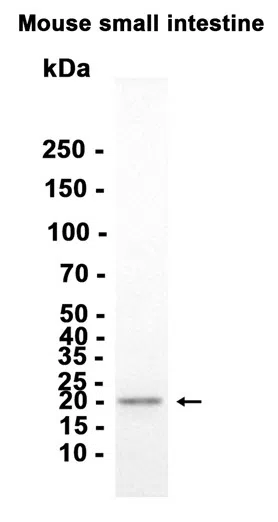
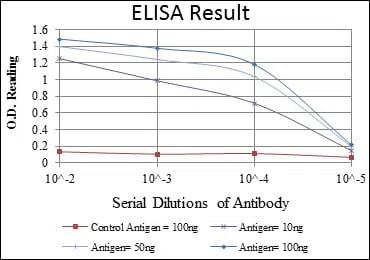
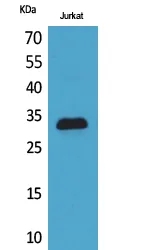
EnkiLife offers the p57 Rabbit Polyclonal Antibody. This antibody reacts with Human,Mouse,Rat species and is suitable for WB,IHC,ICC/IF,ELISA application. Alternative Names of Immunogen: CDKN1C; KIP2; Cyclin-dependent kinase inhibitor 1C; Cyclin-dependent kinase inhibitor p57; p57Kip2. The product boasts remarkable high specificity, outstanding reproducibility, and exceptional affinity, making it a reliable and superior choice for your needs. Dilution Ratio: WB 1:500-1:2000,IHC 1:100-1:300,ICC/IF 1:50-1:200,ELISA 1:10000-1:20000 Background: This gene is imprinted, with preferential expression of the maternal allele. The encoded protein is a tight-binding, strong inhibitor of several G1 cyclin/Cdk complexes and a negative regulator of cell proliferation. Mutations in this gene are implicated in sporadic cancers and Beckwith-Wiedemann syndorome, suggesting that this gene is a tumor suppressor candidate. Three transcript variants encoding two different isoforms have been found for this gene. [provided by RefSeq, Oct 2010],disease:Defects in CDKN1C are a cause of Beckwith-Wiedemann syndrome (BWS) [MIM:130650]. BWS is a genetically heterogeneous disorder characterized by anterior abdominal wall defects including exomphalos (omphalocele), pre- and postnatal overgrowth, and macroglossia. Additional less frequent complications include specific developmental defects and a predisposition to embryonal tumors.,disease:Defects in CDKN1C are involved in tumor formation.,function:Potent tight-binding inhibitor of several G1 cyclin/CDK complexes (cyclin E-CDK2, cyclin D2-CDK4, and cyclin A-CDK2) and, to lesser extent, of the mitotic cyclin B-CDC2. Negative regulator of cell proliferation. May play a role in maintenance of the non-proliferative state throughout life.,similarity:Belongs to the CDI family.,tissue specificity:Expressed in the heart, brain, lung, skeletal muscle, kidney, pancreas and testis. High levels are seen in the placenta while low levels are seen in the liver., Research Area: Cell_Cycle_G1S;Cell_Cycle_G2M_DNA;
More from EnkiLife