Phospho-CD44 (Ser706) Rabbit Polyclonal Antibody
APRab04404-50μL · 50μL
Verified Partner
Sign in to see pricing and request a quote.
Brand Store Product
No external links. Get your quote directly here.

Description
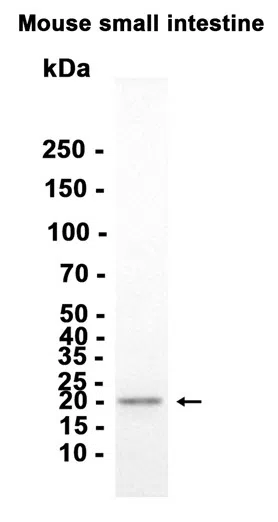
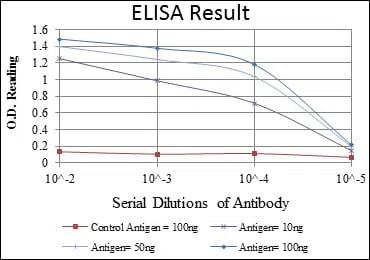
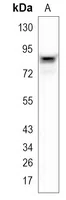
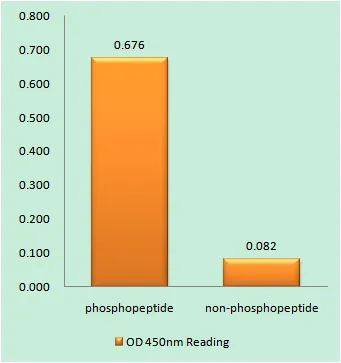
EnkiLife offers the Phospho-CD44 (Ser706) Rabbit Polyclonal Antibody. This antibody reacts with Human,Mouse,Rat species and is suitable for WB,ELISA application. Alternative Names of Immunogen: CD44; LHR; MDU2; MDU3; MIC4; CD44 antigen; CDw44; Epican; Extracellular matrix receptor III; ECMR-III; GP90 lymphocyte homing/adhesion receptor; HUTCH-I; Heparan sulfate proteoglycan; Hermes antigen; Hyaluronate receptor; Phagocytic glycopr. The product boasts remarkable high specificity, outstanding reproducibility, and exceptional affinity, making it a reliable and superior choice for your needs. Dilution Ratio: WB 1:500-1:2000,ELISA 1:10000-1:20000 Background: The protein encoded by this gene is a cell-surface glycoprotein involved in cell-cell interactions, cell adhesion and migration. It is a receptor for hyaluronic acid (HA) and can also interact with other ligands, such as osteopontin, collagens, and matrix metalloproteinases (MMPs). This protein participates in a wide variety of cellular functions including lymphocyte activation, recirculation and homing, hematopoiesis, and tumor metastasis. Transcripts for this gene undergo complex alternative splicing that results in many functionally distinct isoforms, however, the full length nature of some of these variants has not been determined. Alternative splicing is the basis for the structural and functional diversity of this protein, and may be related to tumor metastasis. [provided by RefSeq, Jul 2008],alternative products:Additional isoforms seem to exist. Additional isoforms are produced by alternative splicing of 10 out of 19 exons within the extracellular domain. Additional diversity is generated through the utilization of internal splice donor and acceptor sites within 2 of the exons. A variation in the cytoplasmic domain was shown to result from the alternative splicing of 2 exons. Isoform CD44 is expected to be expressed in normal cells. Splice variants have been found in many tumor cell lines. Exons 5, 6, 7, 8, 9, 10, 11, 13, 14 and 19 are alternatively spliced. Experimental confirmation may be lacking for some isoforms,function:Receptor for hyaluronic acid (HA). Mediates cell-cell and cell-matrix interactions through its affinity for HA, and possibly also through its affinity for other ligands such as osteopontin, collagens, and matrix metalloproteinases (MMPs). Adhesion with HA plays an important role in cell migration, tumor growth and progression. Also involved in lymphocyte activation, recirculation and homing, and in hematopoiesis. Altered expression or dysfunction causes numerous pathogenic phenotypes. Great protein heterogeneity due to numerous alternative splicing and post-translational modification events.,online information:Blood group antigen gene mutation database,online information:CD44 entry,polymorphism:CD44 is responsible for the Indian blood group system. The molecular basis of the In(A)=In1/In(B)=In2 blood group antigens is a single variation in position 46; In(B), the most frequent allele, has Arg-46.,PTM:N-glycosylated.,PTM:O-glycosylated; contains more-or-less-sulfated chondroitin sulfate glycans, whose number may affect the accessibility of specific proteinases to their cleavage site(s).,PTM:Phosphorylated; activation of PKC results in the dephosphorylation of Ser-706 (constitutive phosphorylation site), and the phosphorylation of Ser-672.,PTM:Proteolytically cleaved in the extracellular matrix by specific proteinases (possibly MMPs) in several cell lines and tumors.,similarity:Contains 1 Link domain.,subunit:Interacts with HA, as well as other glycosaminoglycans, collagen, laminin, and fibronectin via its N-terminal segment. Interacts with ANK, the ERM proteins (VIL2, RDX and MSN), and NF2 via its C-terminal segment.,tissue specificity:An epithelial isoform (CD44E) is expressed by cells of epithelium and highly expressed by carcinomas. An hematopoietic isoform (CD44H) is expressed by cells of mesodermal origin. Expression is repressed in neuroblastoma cells., Research Area: ECM-receptor interaction;Hematopoietic cell lineage;
More from EnkiLife