Phospho-Zyxin (Ser142) Rabbit Polyclonal Antibody
APRab05647-20μL · 20μL
Verified Partner
Sign in to see pricing and request a quote.
Brand Store Product
No external links. Get your quote directly here.

Description
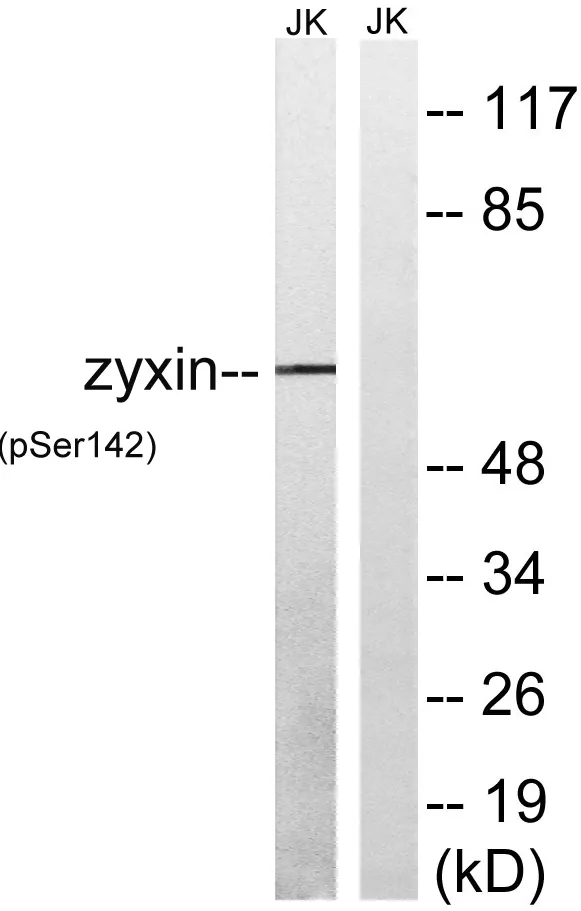
EnkiLife offers the Phospho-Zyxin (Ser142) Rabbit Polyclonal Antibody. This antibody reacts with Human,Rat,Mouse species and is suitable for WB,ELISA application. Alternative Names of Immunogen: ZYX; Zyxin; Zyxin-2. The product boasts remarkable high specificity, outstanding reproducibility, and exceptional affinity, making it a reliable and superior choice for your needs. Dilution Ratio: WB 1:500-1:2000,ELISA 1:5000-1:10000 Background: Focal adhesions are actin-rich structures that enable cells to adhere to the extracellular matrix and at which protein complexes involved in signal transduction assemble. Zyxin is a zinc-binding phosphoprotein that concentrates at focal adhesions and along the actin cytoskeleton. Zyxin has an N-terminal proline-rich domain and three LIM domains in its C-terminal half. The proline-rich domain may interact with SH3 domains of proteins involved in signal transduction pathways while the LIM domains are likely involved in protein-protein binding. Zyxin may function as a messenger in the signal transduction pathway that mediates adhesion-stimulated changes in gene expression and may modulate the cytoskeletal organization of actin bundles. Alternative splicing results in multiple transcript variants that encode the same isoform. [provided by RefSeq, Jul 2008],function:Adhesion plaque protein. Binds alpha-actinin and the CRP protein. May be a component of a signal transduction pathway that mediates adhesion-stimulated changes in gene expression.,similarity:Belongs to the zyxin/ajuba family.,similarity:Contains 3 LIM zinc-binding domains.,subcellular location:Associates with the actin cytoskeleton near the adhesion plaques. Enters the nucleus in the presence of HESX1.,subunit:Interacts with HPV type 6 protein E6. Does not interact significantly with E6 proteins from HPV types 11, 16, or 18. Interacts, via the Pro-rich regions, with the EVH1 domains of ENAH and VASP. Interaction with ENA/VASP family members is important for their targeting to focal adhesions and the formation of actin-rich structures., Research Area: Focal adhesion;
More from EnkiLife