Puratrophin 1 Rabbit Polyclonal Antibody
APRab16698-20μL · 20μL
Verified Partner
Sign in to see pricing and request a quote.
Brand Store Product
No external links. Get your quote directly here.

Description
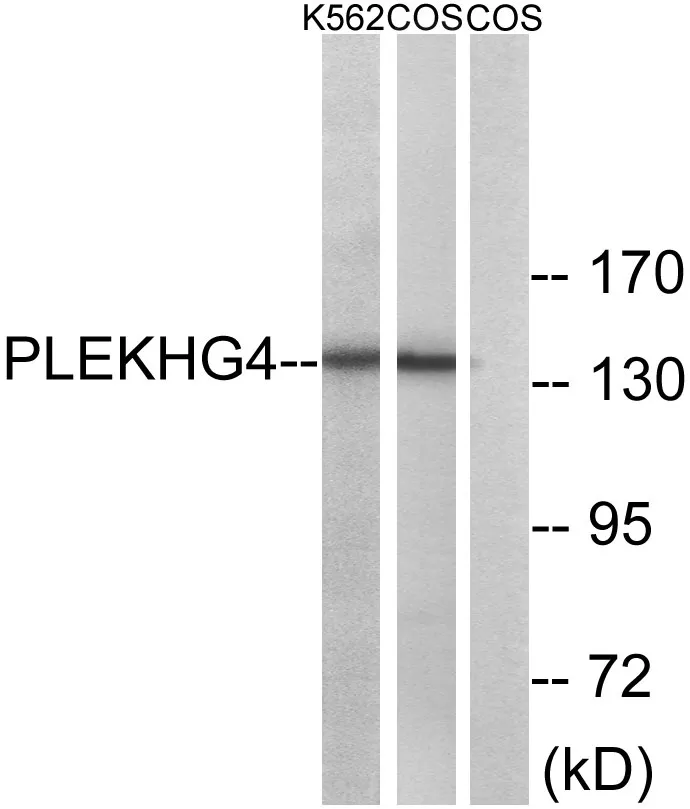
EnkiLife offers the Puratrophin 1 Rabbit Polyclonal Antibody. This antibody reacts with Human,Monkey species and is suitable for WB,IHC,ICC/IF,ELISA application. Alternative Names of Immunogen: PLEKHG4; PRTPHN1; Puratrophin-1; Pleckstrin homology domain-containing family G member 4; PH domain-containing family G member 4; Purkinje cell atrophy-associated protein 1. The product boasts remarkable high specificity, outstanding reproducibility, and exceptional affinity, making it a reliable and superior choice for your needs. Dilution Ratio: WB 1:500-1:2000,IHC 1:100-1:300,ICC/IF 1:50-1:200,ELISA 1:10000-1:20000 Background: The protein encoded by this gene can function as a guanine nucleotide exchange factor (GEF) and may play a role in intracellular signaling and cytoskeleton dynamics at the Golgi apparatus. Polymorphisms in the region of this gene have been found to be associated with spinocerebellar ataxia in some study populations. Alternative splicing results in multiple transcript variants. [provided by RefSeq, Jan 2015],disease:Defects in PLEKHG4 are the cause of spinocerebellar ataxia 16q22-linked (SCA16q22) [MIM:117210]; alo known as pure spinocerebellar ataxia Japanese type or SCA4 pure Japanese type. Spinocerebellar ataxia is a clinically and genetically heterogeneous group of cerebellar disorders. Patients show progressive incoordination of gait and often poor coordination of hands, speech and eye movements, due to degeneration of the cerebellum with variable involvement of the brainstem and spinal cord. SCA16q22 belongs to the autosomal dominant cerebellar ataxias type III (ADCA III) which are characterized by pure cerebellar ataxia without additional signs.,function:Possible role in intracellular signaling and cytoskeleton dynamics at the Golgi.,similarity:Contains 1 DH (DBL-homology) domain.,similarity:Contains 1 PH domain.,tissue specificity:Expressed in kidney, Leydig cells in the testis, epithelial cells in the prostate gland and Langerhans islet in the pancreas. Isoform 1 and isoform 3 are strongly expressed in Purkinje cells and to a lower extent in other neurons (at protein level). Widely expressed at low levels. More strongly expressed in testis and pancreas.,
More from EnkiLife