Recombinant Cynomolgus CD3E (C-Fc)
PHV2008-50ug · 50ug
Verified Partner
Sign in to see pricing and request a quote.
Brand Store Product
No external links. Get your quote directly here.

Description
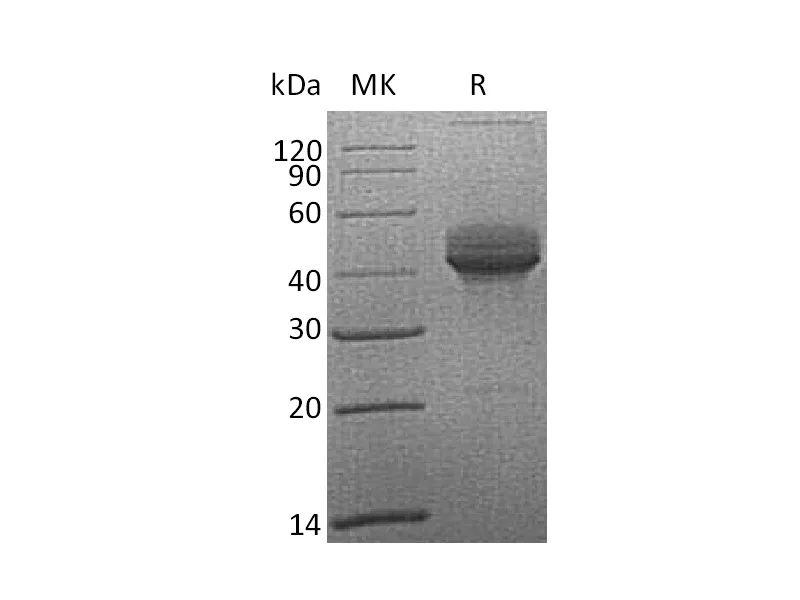
EnkiLife provides the Recombinant Cynomolgus CD3E (C-Fc) protein,aslo know as CD3 epsilon,CD3e antigen,CD3e antigen, epsilon polypeptide (TiT3 complex),CD3e molecule, epsilon (CD3-TCR complex),CD3e,CD3-epsilon,FLJ18683,T3E,T-cell antigen receptor complex, epsilon subunit of T3,T-cell surface antigen T3/Leu-4 epsilon chain,T-cell surface glycoprotein CD3 epsilon chain,TCRE, which features high purity, high activity, and high stability. It can be applied in scientific research, biopharmaceuticals, and other fields.Purity:Greater than 95% as determined by reducing SDS-PAGE;Endotoxin Level:<1 EU/µg as determined by LAL test.;Construction:Recombinant Cynomolgus T-cell Surface Glycoprotein CD3 Epsilon Chain is produced by our Mammalian expression system and the target gene encoding Gln22-Asp117 is expressed with a human IgG1 Fc tag at the C-terminus.Accession:Q95LI5. Expression Host:Human Cells.Species:Cynomolgus.Predicted Molecular Mass:38 KDa. Background:T-cell surface glycoprotein CD3 epsilon chain, also known as CD3E, is a single-pass type I membrane protein. CD3E contains 1 Ig-like (immunoglobulin-like) domain and 1 ITAM domain. CD3E, together with CD3-gamma, CD3-delta and CD3-zeta, and the T-cell receptor alpha/beta and gamma/delta heterodimers, forms the T cell receptor-CD3 complex. The CD3 epsilon subunit of the T cell receptor (TCR) complex contains two defined signaling domains, a proline-rich sequence and an immune tyrosine activation motifs (ITAMs), and this complex undergoes a conformational change upon ligand binding that is thought to be important for the activation of T cells. T cell receptor-CD3 complex plays an important role in coupling antigen recognition to several intracellular signal-transduction pathways. This complex is critical for T-cell development and function, and represents one of the most complex transmembrane receptors. CD3E plays an essential role in T-cell development, and defects in CD3E gene cause severe immunodeficiency. Homozygous mutations in CD3D and CD3E genes lead to a complete block in T-cell development and thus to an early-onset severe combined immunodeficiency phenotype.
More from EnkiLife