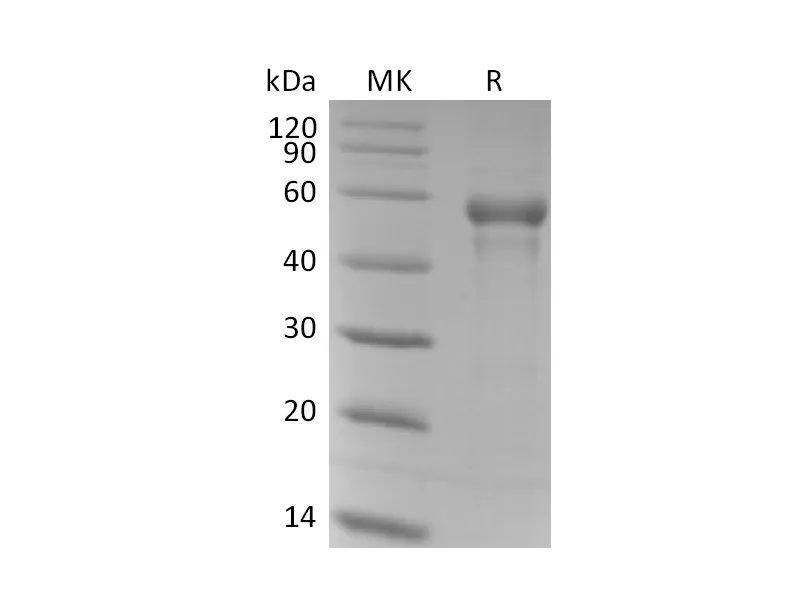
Recombinant Human B3GAT1 (N-6His)
PHH2324-10ug · 10ug
Verified Partner
Sign in to see pricing and request a quote.
Brand Store Product
No external links. Get your quote directly here.

Description
EnkiLife provides the Recombinant Human B3GAT1 (N-6His) protein,aslo know as B3GAT1,beta-1,3-glucuronyltransferase 1 (glucuronosyltransferase P),CD57,GlcAT-P,HNK1,NK1,NK-1, which features high purity, high activity, and high stability. It can be applied in scientific research, biopharmaceuticals, and other fields.Purity:Greater than 95% as determined by reducing SDS-PAGE;Endotoxin Level:<1 EU/µg as determined by LAL test.;Construction:Recombinant Human Galactosylgalactosylxylosylprotein 3-beta-glucuronosyltransferase 1 is produced by our Mammalian expression system and the target gene encoding His25-Ile334 is expressed with a 6His tag at the N-terminus.Accession:Q9P2W7. Expression Host:Human Cells.Species:Human.Predicted Molecular Mass:36.2 KDa. Background:B3GAT1 is the key enzyme during the biosynthesis of the carbohydrate epitope HNK-1, which is present on a number of cell adhesion molecules important in neurodevelopment. It adds a glucuronic residue to the terminal lactosamine residue (Gal beta 14GlcNAc) of a glycoprotein or glycolipid, which can be further sulfated to become the HNK1 epitope, a unique trisaccharide structure, HSO3-3GlcA beta 1-3Gal beta 1-4GlcNAc. The enzyme activity was found to be enhanced in the presence of sphingomyelin and phosphatidylinositol. The HNK1 carbohydrate epitope is characteristically expressed on a series of cell adhesion molecules in addition to some glycolipids in the extracellular matrix and on the cell surface in the nervous system, where it is involved in cell-cell and cell-substratum interaction and recognition during the development of the nervous system. Like most known glycosyltransferases, B3GAT1 is a type II Golgi-resident transmembrane protein with a short N-terminal cytoplasmic domain and a single pass transmembrane domain followed by an enzymatic domain in the lumen of Golgi apparatus. The enzyme activity was assayed using a phosphatase-coupled method.
More from EnkiLife