Recombinant Human B4GALT1 (C-6His)
PHH2132-500ug · 500ug
Verified Partner
Sign in to see pricing and request a quote.
Brand Store Product
No external links. Get your quote directly here.

Description
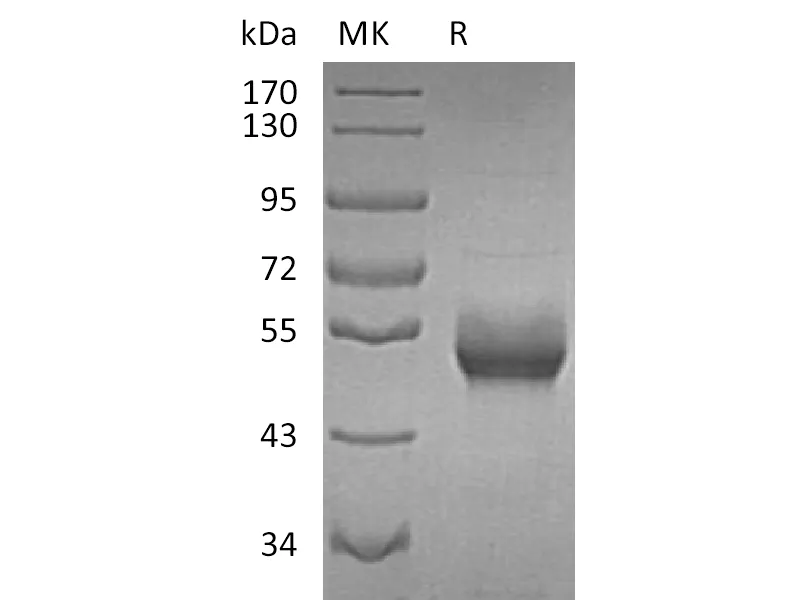
EnkiLife provides the Recombinant Human B4GALT1 (C-6His) protein,aslo know as 1,4- galactosyltransferase, polypeptide 1,B4GalT1,B4GAL-T1,beta-1,4-galactosyltransferase 1,Beta-1,4-GalTase 1,beta4Gal-T1,betaGlcNAc beta,CDG2D,GT1,GTB, which features high purity, high activity, and high stability. It can be applied in scientific research, biopharmaceuticals, and other fields.Purity:Greater than 95% as determined by reducing SDS-PAGE;Endotoxin Level:<1 EU/µg as determined by LAL test.;Construction:Recombinant Human Beta-1,4-galactosyltransferase 1 is produced by our Mammalian expression system and the target gene encoding Gly44-Ser398(Tyr285Leu) is expressed with a 6His tag at the C-terminus.Accession:P15291. Expression Host:Human Cells.Species:Human.Predicted Molecular Mass:40.1 KDa. Background:Beta1,4-Galactosyltransferase-I (B4GALT1), one of seven beta1,4-galactosyltransferases, is an enzyme commonly found in the trans-Golgi complex that adds galactose to oligosaccharides. By sequence similarity, the beta 4GalTs form four groups: beta 4GalT1 and beta 4GalT2, beta 4GalT3 and beta 4GalT4, beta 4GalT5 and beta 4GalT6, and beta 4GalT7. beta 4GalT1 is unique among the seven enzymes because it can be expressed either as membrane associated form or secreted form. The secreted form is restricted to lactating mammary tissues where the enzyme forms a heterodimer with alpha -lactalbumin to catalyze the synthesis of lactose. The Golgi complex form catalyzes the production of lactose in the lactating mammary gland and could also be responsible for the synthesis of complex-type N-linked oligosaccharides in many glycoproteins as well as the carbohydrate moieties of glycolipids. The cell surface form functions as a recognition molecule during a variety of cell to cell and cell to matrix interactions, as those occurring during development and egg fertilization, by binding to specific oligosaccharide ligands on opposing cells or in the extracellular matrix. Defects in beta 4GalT1 are the cause of congenital disorder of glycosylation type 2D (CDG2D) .
More from EnkiLife