Recombinant Human CORO6 (N-6His)
PEH0447-50ug · 50ug
Verified Partner
Sign in to see pricing and request a quote.
Brand Store Product
No external links. Get your quote directly here.

Description
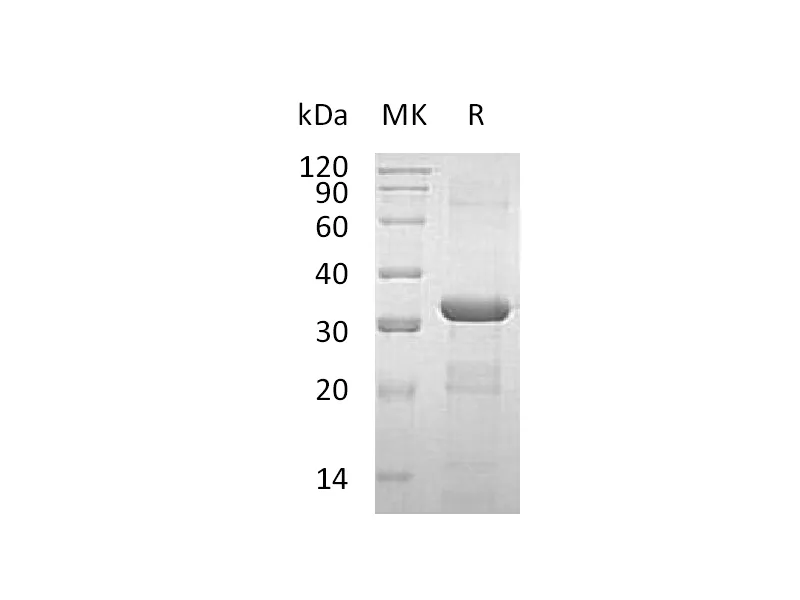
EnkiLife provides the Recombinant Human CORO6 (N-6His) protein,aslo know as Coronin-6,Clipin-E,CORO6, which features high purity, high activity, and high stability. It can be applied in scientific research, biopharmaceuticals, and other fields.Purity:Greater than 95% as determined by reducing SDS-PAGE;Endotoxin Level:<1 EU/µg as determined by LAL test.;Construction:Recombinant Human Coronin-6 is produced by our E.coli expression system and the target gene encoding Met1-Asp237 is expressed with a 6His tag at the N-terminus.Accession:Q6QEF8-4. Expression Host:E.coli.Species:Human.Predicted Molecular Mass:28.3 KDa. Background:Coronin 6, a newly identified member of the coronin family, is highly enriched at adult NMJs and regulates AChR clustering via modulating the interaction between receptors and the actin cytoskeletal network. Coronins are a family of conserved actin-binding proteins originally identified in the actin-rich structure of the amoeba Dictyostelium discoideum . To date, seven members of coronins have been identified in mammals, and most exhibit tissue-specific distribution patterns. Coronin 6 is prominently expressed in adult muscle and enriched at the NMJ. Studies with cultured myotubes reveal that Coronin 6 regulates both agrin- and laminin-induced AChR clustering and is important for anchoring AChRs onto the actin cytoskeleton. Also, both the C-terminal region and a conserved Arg29 residue at the N terminus of Coronin 6 are essential for its actin-binding activity and stabilization of AChR–cytoskeleton linkage. Importantly, in vivo knockdown of Coronin 6 in mouse skeletal muscle fibers leads to destabilization of AChR clusters, which demonstrates that Coronin 6 is a critical regulator of AChR clustering at the postsynaptic region of the NMJs through modulating the receptor-anchored actin cytoskeleton. The human Coronin 6 has five isoforms produced by alternative splicing, and tissue-specific expression of these isoforms are unclear.
More from EnkiLife