Recombinant Human DLL4 (C-Fc)
PHH2303-10ug · 10ug
Verified Partner
Sign in to see pricing and request a quote.
Brand Store Product
No external links. Get your quote directly here.

Description
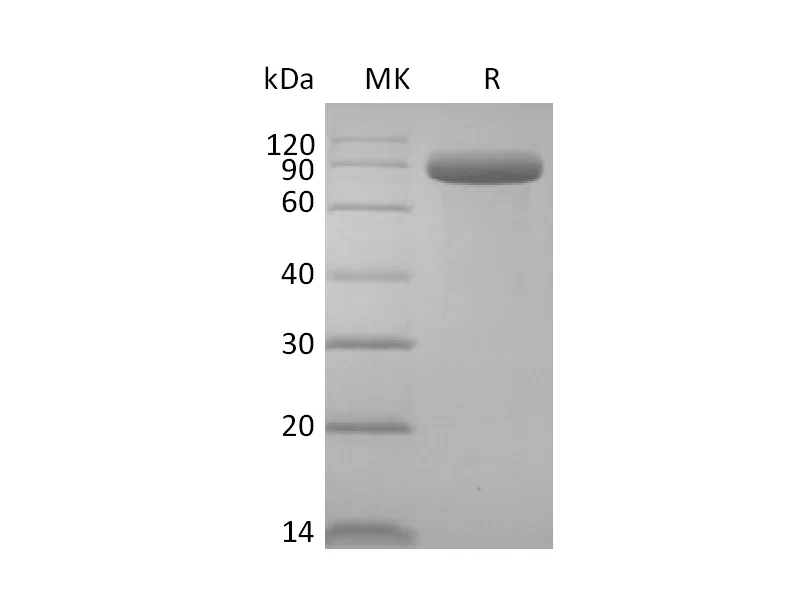
EnkiLife provides the Recombinant Human DLL4 (C-Fc) protein,aslo know as Delta-like protein 4,Drosophila Delta homolog 4,Delta4,DLL4, which features high purity, high activity, and high stability. It can be applied in scientific research, biopharmaceuticals, and other fields.Purity:Greater than 95% as determined by reducing SDS-PAGE;Endotoxin Level:<1 EU/µg as determined by LAL test.;Construction:Recombinant Human Delta-like Protein 4 is produced by our Mammalian expression system and the target gene encoding Ser27-Pro524 is expressed with a human IgG1 Fc tag at the C-terminus.Accession:Q9NR61. Expression Host:Human Cells.Species:Human.Predicted Molecular Mass:81.2 KDa. Background:Delta-like protein 4 (DLL4) is a type I membrane protein belonging to the Delta/Serrate/Lag2 (DSL) family of Notch ligands. In mammals, four Notch homologs (Notch 1 to4) and five ligands (DLL 1, 3 and 4, Jagged 1 and 2) have been identified. DLL4 is expressed highly and selectively within the arterial endothelium and has been shown to function as a ligand for Notch 1 and Notch 4. Human and mouse DLL4 shares 86% amino acid sequence identity. Notch ligands are transmembrane proteins with a DSL motif necessary for Notch binding, tandem EGF repeats, a transmembrane region and a short intracellular domain (ICD). Notch ligands are categorized into two subfamilies based on the presence of an extracellular cysteinerich domain and insertions that interrupt some EGF repeats in the Jagged but not the Delta ligand family. Interactions of Notch receptors with their ligands result in reciprocal regulated intramembrane proteolysis (RIP). RIP is a mechanism for transmembrane signal transduction that involves the sequential processing by a disintegrin metalloprotease (ADAM) and then by presenilin/ γ secretase, resulting in shedding of the extracellular domains and the generation of the soluble ICD signaling fragments, respectively.
More from EnkiLife