Recombinant Human SUMO1 (N-6His)
PEH1589-10ug · 10ug
Verified Partner
Sign in to see pricing and request a quote.
Brand Store Product
No external links. Get your quote directly here.

Description
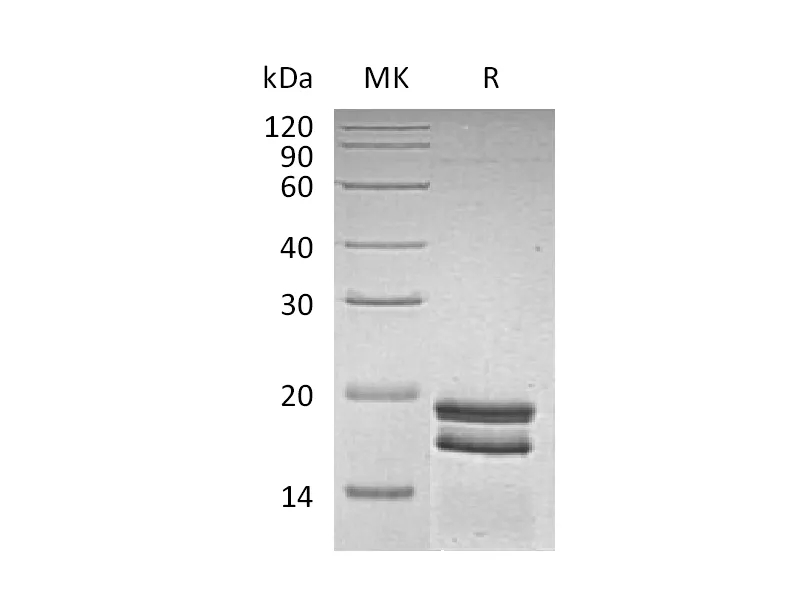
EnkiLife provides the Recombinant Human SUMO1 (N-6His) protein,aslo know as Small Ubiquitin-Related Modifier 1,SUMO-1,GAP-Modifying Protein 1,GMP1,SMT3 Homolog 3,Sentrin,Ubiquitin-Homology Domain Protein PIC1,Ubiquitin-Like Protein SMT3C,Smt3C,Ubiquitin-Like Protein UBL1,SUMO1,SMT3C,SMT3H3,UBL1, which features high purity, high activity, and high stability. It can be applied in scientific research, biopharmaceuticals, and other fields.Purity:Greater than 95% as determined by reducing SDS-PAGE;Endotoxin Level:<1 EU/µg as determined by LAL test.;Construction:Recombinant Human Small Ubiquitin-Related Modifier 1 is produced by our E.coli expression system and the target gene encoding Met1-Val101 is expressed with a 6His tag at the N-terminus.Accession:AAH66306. Expression Host:E.coli.Species:Human.Predicted Molecular Mass:13.7 KDa. Background:Small Ubiquitin-Related Modifier 1 (SUMO1) is an Ubiquitin-like protein that belongs to the ubiquitin family with SUMO subfamily. It is a family of small, related proteins that can be enzymatically attached to a target protein by a post-translational modification process termed sumoylation. SUMO1 functions in a manner similar to ubiquitin in that it is bound to target proteins as part of a post-translational modification system. This post-translational modification on lysine residues of proteins plays a crucial role in a number of cellular processes such as nuclear transport, DNA replication and repair, mitosis and signal transduction. SUMO1 is involved in a variety of cellular processes, such as nuclear transport, transcriptional regulation, apoptosis, and protein stability. SUMO1 is not active until the last four amino acids of the carboxy-terminus are cleaved off. Polymeric SUMO1 chains are also susceptible to polyubiquitination which functions as a signal for proteasomal degradation of modified proteins and may also regulate a network of genes involved in palate development.
More from EnkiLife