Recombinant Human uPAR (C-6His)
PHH1791-50ug · 50ug
Verified Partner
Sign in to see pricing and request a quote.
Brand Store Product
No external links. Get your quote directly here.

Description
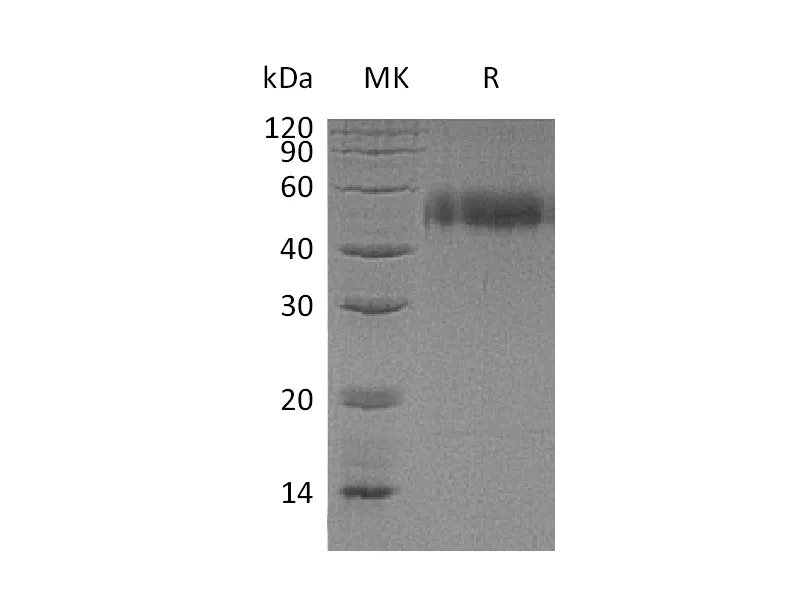
EnkiLife provides the Recombinant Human uPAR (C-6His) protein,aslo know as Urokinase Plasminogen Activator Surface Receptor,U-PAR,uPAR,Monocyte activation antigen Mo3,CD87,PLAUR,MO3,UPAR, which features high purity, high activity, and high stability. It can be applied in scientific research, biopharmaceuticals, and other fields.Purity:Greater than 95% as determined by reducing SDS-PAGE;Endotoxin Level:<1 EU/µg as determined by LAL test.;Construction:Recombinant Human Urokinase Plasminogen Activator Surface Receptor is produced by our Mammalian expression system and the target gene encoding Leu23-Arg303 is expressed with a 6His tag at the C-terminus.Accession:Q03405. Expression Host:Human Cells.Species:Human.Predicted Molecular Mass:32.4 KDa. Background:The Urokinase Type Plasminogen Activator (uPA) receptor (uPAR) is a widely expressed receptor for urokinase plasminogen activator (uPA) and pro-uPA. uPAR / CD87 is a highly glycosylated, 55-60kDa integral membrane protein linked to the plasma membrane by a glycosylphosphatidylinositol (GPI) anchor. uPAR is expressed by T-cells, NK cells, monocytes, and neutrophils as well as non-hematopoietic cells that include vascular endothelial cells, fibroblasts, smooth muscle cells, keratinocytes, placental trophoblasts, hepatocytes, and a wide variety of tumor cells (including breast, colon, and prostate carcinoma, melanoma). It plays a critical role in the regulation of cell-surface plasminogen activation in physiological and pathological conditions, and it is also involved in cellular adhesion, the transmission of extracellular signals across the plasma membrane and the subsequent regulation of gene expression. uPAR has been implicated in several biological processes including angiogenesis, monocyte migration, cancer metastasis, trophoblast implantation, and wound healing. Human uPAR is encoded as a 313 amino acid residue polypeptide, excluding a 22 residue signal peptide and shows 60-70% similarity with the murine uPAR amino acid sequence although binding of uPA to uPAR shows strong species specificity.
More from EnkiLife