Recombinant Human VEGF-C (C-6His)
PHH1809-500ug · 500ug
Verified Partner
Sign in to see pricing and request a quote.
Brand Store Product
No external links. Get your quote directly here.
Description
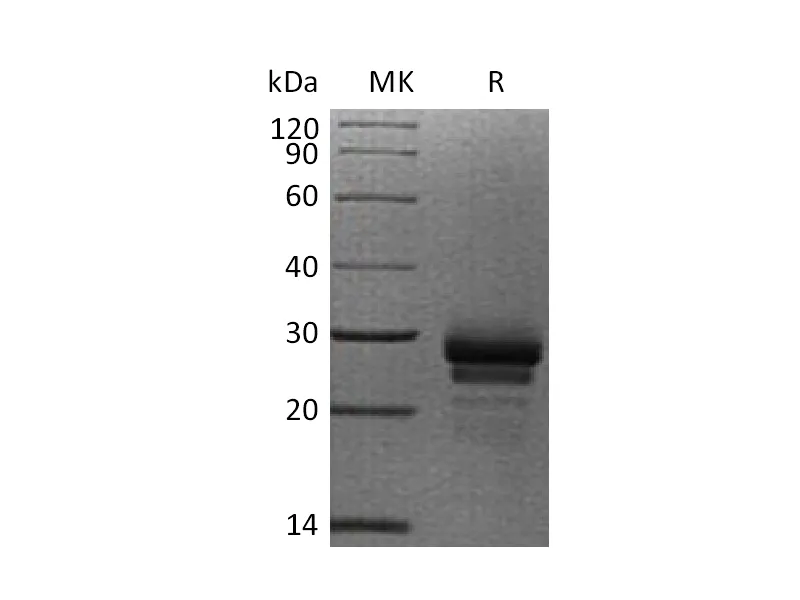
EnkiLife provides the Recombinant Human VEGF-C (C-6His) protein,aslo know as Vascular Endothelial Growth Factor C,VEGF-C,Flt4 Ligand,Flt4-L,Vascular Endothelial Growth Factor-Related Protein,VRP,VEGFC, which features high purity, high activity, and high stability. It can be applied in scientific research, biopharmaceuticals, and other fields.Purity:Greater than 95% as determined by reducing SDS-PAGE;Endotoxin Level:<1 EU/µg as determined by LAL test.;Construction:Recombinant Human Vascular Endothelial Growth Factor C is produced by our Mammalian expression system and the target gene encoding Phe32-Arg227 is expressed with a 6His tag at the C-terminus.Accession:P49767. Expression Host:Human Cells.Species:Human.Predicted Molecular Mass:23.27 KDa. Background:Vascular Endothelial Growth Factor (VEGF)-C is a member of the VEGF family, a group of polypeptide growth factors which play key roles in the physiology and pathology of many aspects of the cardiovascular system, including vasculogenesis, hematopoiesis, angiogenesis and vascular permeability. While VEGFC is homologous to other members of the VEGF/PDGF family, it contains the C-terminal propeptide which has an unusual structure with tandemly repeated cysteine-rich motifs. Upon biosynthesis, VEGFC is secreted as a non-covalent momodimer in an anti-parellel fashion. VEGF signalling in endothelial cells occurs through three tyrosine kinase receptors (VEGFRs) expressed by endothelial cells and hematopoietic precursors, and VEGF-C is a ligand for two receptors, VEGFR-3 (Flt4), and VEGFR-2. It is indicated that VEGFC undergoes a complex proteolytic maturation generating a variety of processed secreted forms with increased activity toward VEGFR-3, but only the fully processed form could activate VEGFR-2. VEGFC may function in angiogenesis of the venous and lymphatic vascular systems during embryogenesis, and also in the maintenance of differentiated lymphatic endothelium in adults. Knockout of the VEGF-C gene is embryonic lethal late in development, and although cells differentiate into the lymphatic lineage, they fail to sprout and form lymphatic vessels. Inactivation of a single VEGF-C allele results in the development of cutaneous lymphatic hypoplasia and lymphedema.
More from EnkiLife