Recombinant Human VNN1 (C-6His)
PHH1800-10ug · 10ug
Verified Partner
Sign in to see pricing and request a quote.
Brand Store Product
No external links. Get your quote directly here.

Description
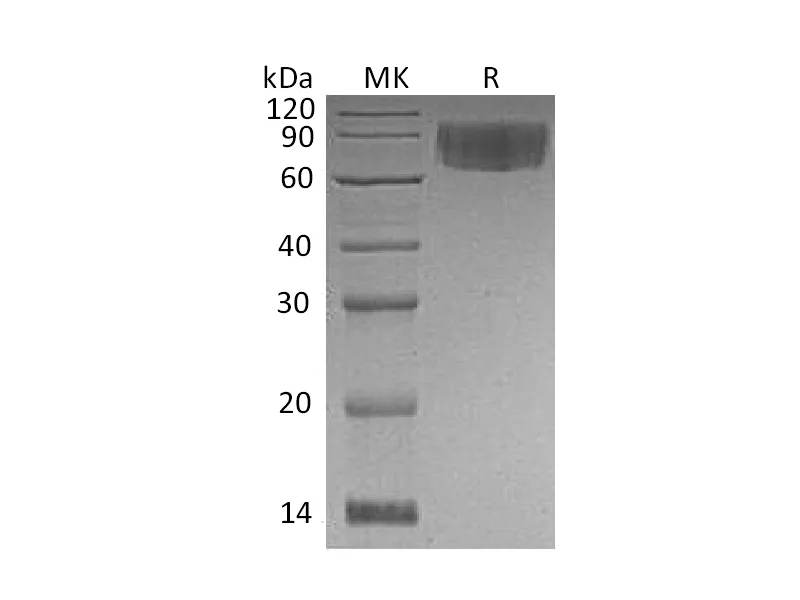
EnkiLife provides the Recombinant Human VNN1 (C-6His) protein,aslo know as Pantetheinase,Pantetheine Hydrolase,Tiff66,Vascular Non-Inflammatory Molecule 1,Vanin-1,VNN1, which features high purity, high activity, and high stability. It can be applied in scientific research, biopharmaceuticals, and other fields.Purity:Greater than 95% as determined by reducing SDS-PAGE;Endotoxin Level:<1 EU/µg as determined by LAL test.;Construction:Recombinant Human Vascular Non-Inflammatory Molecule 1 is produced by our Mammalian expression system and the target gene encoding Gln22-Ser490 is expressed with a 6His tag at the C-terminus.Accession:O95497. Expression Host:Human Cells.Species:Human.Predicted Molecular Mass:53.27 KDa. Background:Vanin-1 is a cell membrane protein which contains one CN hydrolase domain and belongs to the CN hydrolase family and BTD/VNN subfamily. Vanin-1 is also a member of the Vanin family of proteins, which share extensive sequence similarity with each other, and also with biotinidase. The family includes secreted and membrane-associated proteins, a few of which have been reported to participate in hematopoietic cell trafficking. Vanin-1 is widely expressed with higher expression in spleen, kidney and blood and overexpressed in lesional psoriatic skin. No biotinidase activity has been demonstrated for any of the vanin proteins; however, they possess pantetheinase activity, which may play a role in oxidative-stress response. Vanin-1 is an epithelial pantetheinase that provides cysteamine to tissue and regulates response to stress. Vanin-1 is expressed by enterocytes, and its absence limits intestinal epithelial cell production of proinflammatory signals. Vanin-1 regulates late adhesion steps of thymus homing under physiological, noninflammatory conditions. The early impact of vanin-1 deficiency on tumor induction was directly correlated to the amount of inflammation and subsequent epithelial proliferation rather than cell death rate. Vanin-1 molecule was shown to be involved in the control of thymus reconstitution following sub-lethal irradiation.
More from EnkiLife