Recombinant Mouse FGF-9 (C-6His)
PEM0664-50ug · 50ug
Verified Partner
Sign in to see pricing and request a quote.
Brand Store Product
No external links. Get your quote directly here.
Description
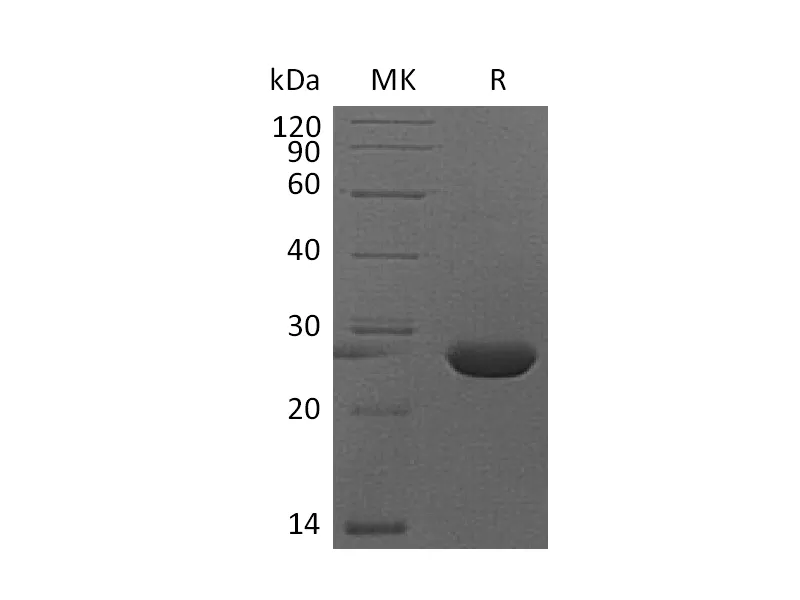
EnkiLife provides the Recombinant Mouse FGF-9 (C-6His) protein,aslo know as Fibroblast growth factor 9,FGF-9,Glia-activating factor,GAF,heparin-binding growth factor-9,HBGF-9,Fgf9,Fgf-9, which features high purity, high activity, and high stability. It can be applied in scientific research, biopharmaceuticals, and other fields.Purity:Greater than 95% as determined by reducing SDS-PAGE;Endotoxin Level:<0.01 EU/µg as determined by LAL test.;Construction:Recombinant Mouse Fibroblast Growth Factor 9 is produced by our E.coli expression system and the target gene encoding Met1/xadSer208 is expressed with a 6His tag at the N-terminus.Accession:P54130. Expression Host:E.coli.Species:Mouse.Predicted Molecular Mass:24.4 KDa. Background:Fibroblast growth factor-9 (FGF-9) is an approximately 26 kDa secreted glycoprotein of the FGF family. Secreted mouse FGF-9 lacks the N-terminal 1-3 aa and shares //u003E98% sequence identity with rat, human, equine, porcine and bovine FGF-9. FGF-9 plays an important role in the regulation of embryonic development, cell proliferation, cell differentiation and cell migration. In the mouse embryo the location and timing of FGF-9 expression affects development of the skeleton, cerebellum, lungs, heart, vasculature, digestive tract, and testes .It may have a role in glial cell growth and differentiation during development, gliosis during repair and regeneration of brain tissue after damage, differentiation and survival of neuronal cells, and growth stimulation of glial tumors. Deletion of mouse FGF-9 is lethal at birth due to lung hypoplasia, and causes rhizomelia, or shortening of the proximal skeleton. An unusual constitutive dimerization of FGF 9 buries receptor interaction sites which lowers its activity, and increases heparin affinity which inhibits diffusion. A spontaneous mouse mutant, Eks, interferes with dimerization, resulting monomeric, diffusible FGF-9 that causes elbow and knee synostoses (joint fusions) due to FGF-9 misexpression in developing joints.
More from EnkiLife