Recombinant Mouse LILRB4 (C-6His)
PHM1087-10ug · 10ug
Verified Partner
Sign in to see pricing and request a quote.
Brand Store Product
No external links. Get your quote directly here.

Description
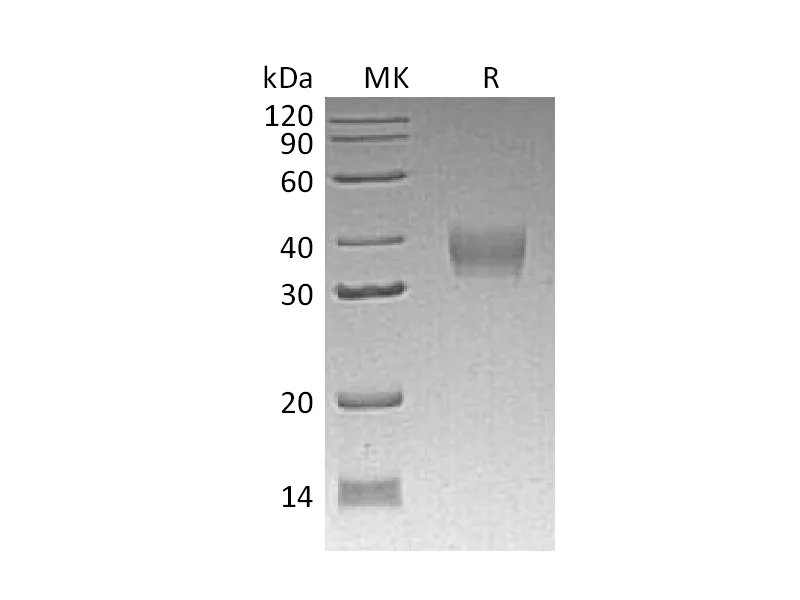
EnkiLife provides the Recombinant Mouse LILRB4 (C-6His) protein,aslo know as Leukocyte immunoglobulin-like receptor subfamily B member 4,Mast cell surface glycoprotein Gp49B,CD85k,Lilrb4,Gp49b, which features high purity, high activity, and high stability. It can be applied in scientific research, biopharmaceuticals, and other fields.Purity:Greater than 95% as determined by reducing SDS-PAGE;Endotoxin Level:<1 EU/µg as determined by LAL test.;Construction:Recombinant Mouse Leukocyte Immunoglobulin-like Receptor Subfamily B Member 4 is produced by our Mammalian expression system and the target gene encoding Gly24-Lys238 is expressed with a 6His tag at the C-terminus.Accession:Q64281. Expression Host:Human Cells.Species:Mouse.Predicted Molecular Mass:24.9 KDa. Background:Mouse Leukocyte Immunoglobulin-like Receptor Subfamily B Member 4 (LILRB4/CD85k/ILT3) is an approximately transmembrane glycoprotein that negatively regulates immune cell activation. Mouse LILRB4 consists of a 215 amino acid (aa) extracellular domain with two Ig-like domains, a 22 aa transmembrane segment, and a 75 aa cytoplasmic domain with 3 immunoreceptor tyrosine-based inhibitory motifs (ITIM). Within the ECD, mouse LILRB4 shares 45% and 77% aa sequence identity with human and rat LILRB4, respectively. Alternative splicing of mouse LILRB4 generates a potentially soluble isoform that lacks the transmembrane segment. LILRB4 is expressed on dendritic cells (DC), monocytes, macrophages, and vascular endothelial cells (EC). Ligation of LILRB4 triggers ITIM-mediated inhibition of cellactivating signaling, leading to enhanced immune tolerance and reduced allogeneic graft rejection. Soluble LILRB4 induces the differentiation of CD8+ T suppressor cells (Ts) that can inhibit the effector functions of CD4+ Th cells and CD8+ CTL. In turn, CD8+ Ts cells induce LILRB4 up-regulation and a tolerogenic phenotype in monocytes, DC, and EC.
More from EnkiLife