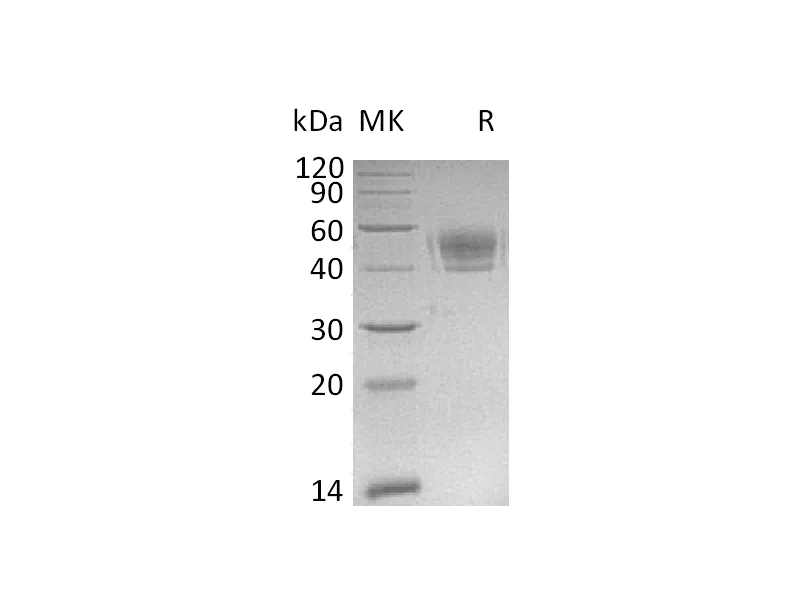
Recombinant Mouse PD-L1 (C-6His)
PHM1293-10ug · 10ug
Verified Partner
Sign in to see pricing and request a quote.
Brand Store Product
No external links. Get your quote directly here.

Description
EnkiLife provides the Recombinant Mouse PD-L1 (C-6His) protein,aslo know as Programmed cell death 1 ligand 1Cd274, programmed cell death 1 ligand 1;PD-L1;PDCD1 ligand 1;programmed death ligand 1;B7 homolog 1;B7-H1;CD274, which features high purity, high activity, and high stability. It can be applied in scientific research, biopharmaceuticals, and other fields.Purity:Greater than 95% as determined by reducing SDS-PAGE;Endotoxin Level:<1 EU/µg as determined by LAL test.;Construction:Recombinant Mouse Programmed Cell Death 1 Ligand 1 is produced by our Mammalian expression system and the target gene encoding Phe19-Thr238 is expressed with a 6His tag at the C-terminus.Accession:Q9EP73. Expression Host:Human Cells.Species:Mouse.Predicted Molecular Mass:25.6 KDa. Background:Mouse Programmed cell death 1 ligand 1(Cd274,PD-L1), is a member of the growing B7 family of immune proteins.It involved in the costimulatory signal essential for T-cell proliferation and IFNG production in a PDCD1-independent manner. Interaction with PDCD1 inhibits T-cell proliferation by blocking cell cycle progression and cytokine production.B7-H1 has been identified as one of two ligands for programmed death1 (PD1), a member of the CD28 family of immunoreceptors. B7-H1 is constitutively expressed in several organs such as heart, skeletal muscle B7-H1 expression is upregulated in a small fraction of activated T and B cells and a much larger fraction of activated monocytes. The costimulatory function of B7-H1 is critical for enhancing maturation and differentiation of T-cells in lymphoid organs.B7-H1 expression is also induced in dendritic cells and keratinocytes after IFN gamma stimulation. Interaction of B7-H1 with PD1 results in inhibition of TCR-mediated proliferation and cytokine production. The B7-H1:PD1 pathway is involved in the negative regulation of some immune responses and may play an important role in the regulation of peripheral tolerance.
More from EnkiLife