Recombinant Mouse SEMA4D (C-Fc)
PHM1480-50ug · 50ug
Verified Partner
Sign in to see pricing and request a quote.
Brand Store Product
No external links. Get your quote directly here.

Description
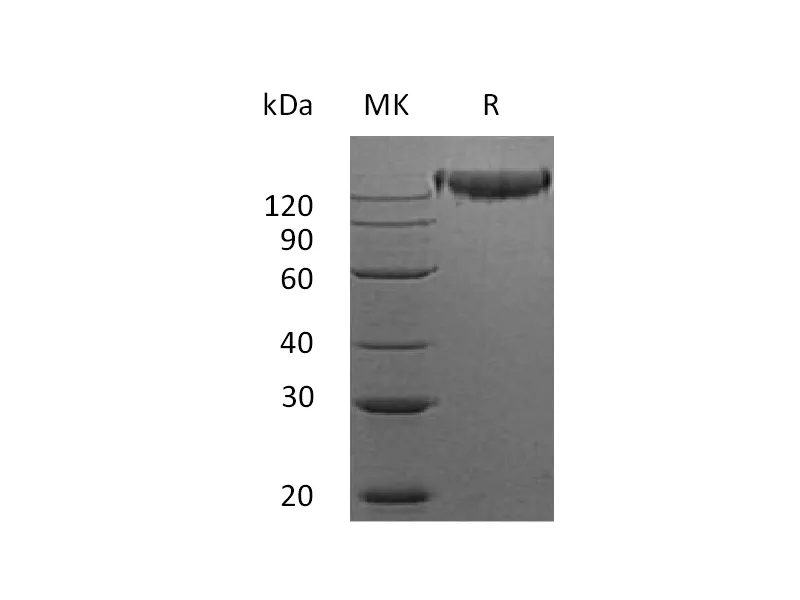
EnkiLife provides the Recombinant Mouse SEMA4D (C-Fc) protein,aslo know as SEMA4D,Semaphorin-4D,M-Sema G,Semaphorin-C-like 2,Semaphorin-J,Sema J,CD100,Semacl2,Semaj, which features high purity, high activity, and high stability. It can be applied in scientific research, biopharmaceuticals, and other fields.Purity:Greater than 95% as determined by reducing SDS-PAGE;Endotoxin Level:<1 EU/µg as determined by LAL test.;Construction:Recombinant Mouse Semaphorin 4D is produced by our Mammalian expression system and the target gene encoding Phe24-Met711 is expressed with a human IgG1 Fc tag at the C-terminus.Accession:O09126. Expression Host:Human Cells.Species:Mouse.Predicted Molecular Mass:103.4 KDa. Background:SEMA4D is a member of the semaphorin family,contains one Ig-like C2-type domain, one PSI domain and one Sema domain. SEMA4D is strongly expressed in lymphoid tissues, especially in the thymus, as well as in the nervous tissues. However, SEMA4D is expressed at lower levels in testes, brain, kidney, small intestine, prostate, heart, placenta, lung and pancreas, but not in colon and liver. SEMA4D is a cell surface receptor for PLXN1B and PLXNB2 that plays an important role in cell-cell signaling. SEMA4D is involved in a number of fundamental biological processes such as promoting reorganization of the actin cytoskeleton, the migration of cerebellar granule cells and of endothelial cells and signaling via SRC and PTK2B/PYK2, which then mediates activation of phosphatidylinositol 3-kinase and of the AKT1 signaling cascade. Not only these, it plays a role in axonal growth cone guidance in the developing central nervous system. Semaphorin-4D / SEMA4D may play a functional role in the immune system, as well as in the nervous system. It could induce B-cells to aggregate and improves their viability (in vitro). SEMA4D is involved in regulating dendrite and axon branching and morphogenesis and promoting interaction with PLXNB1 mediates activation of RHOA.
More from EnkiLife