Recombinant Mouse SIRPA (C-MIgG2a)
PHM1530-50ug · 50ug
Verified Partner
Sign in to see pricing and request a quote.
Brand Store Product
No external links. Get your quote directly here.

Description
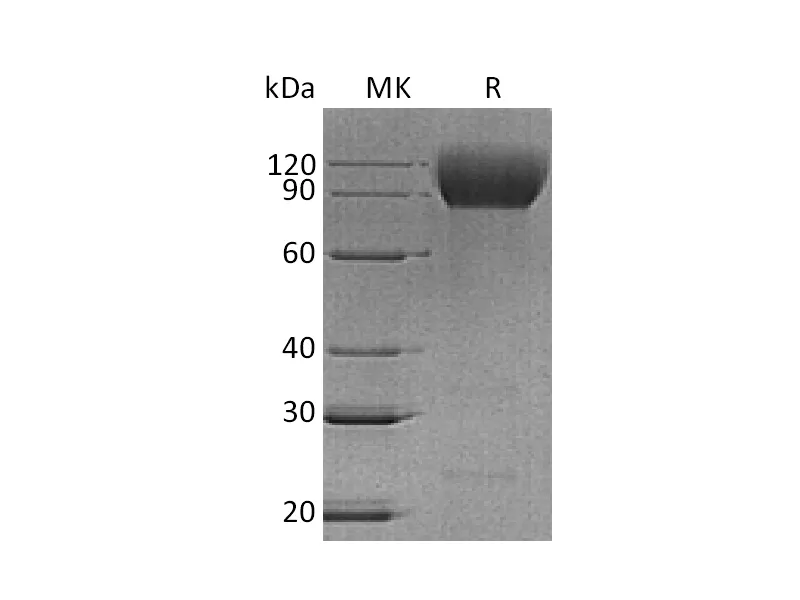
EnkiLife provides the Recombinant Mouse SIRPA (C-MIgG2a) protein,aslo know as Tyrosine-Protein Phosphatase Non-Receptor Type Substrate 1,CD172 Antigen-Like Family Member A,Signal-Regulatory Protein Alpha-1,CD172a,SIRPA,MFR,SHPS1,SIRP, which features high purity, high activity, and high stability. It can be applied in scientific research, biopharmaceuticals, and other fields.Purity:Greater than 95% as determined by reducing SDS-PAGE;Endotoxin Level:<1 EU/µg as determined by LAL test.;Construction:Recombinant Mouse Signal-Regulatory Protein Alpha 1 is produced by our Mammalian expression system and the target gene encoding Lys32-Asn373 is expressedwith a mouse IgG2a tag at the C-terminus.Accession:Q6P6I8. Expression Host:Human Cells.Species:Mouse.Predicted Molecular Mass:65.1 KDa. Background:SIRPα is a type I transmembrane glycoprotein.It contains two Ig-like C1-type domains and one Ig-like V-type domain. Mouse SIRP alpha ECD shares 61%, 75%, 62%, 61%, and 59% aa sequence identity with human, rat, equine, bovine, and porcine SIRP alpha, respectively.SIRPα can express in various tissues, mainly on brain and myeloid cells, including macrophages, neutrophils, dendritic and Langerhans cells. It also can detect in neurons, smooth muscle and endothelial cells. SIRPA is an immunoglobulin-like cell surface receptor for CD47. SIRPα acts as docking protein and induces translocation of PTPN6, PTPN11 and other binding partners from the cytosol to the plasma membrane. SIRPα shows adhesion of cerebellar neurons, neurite outgrowth and glial cell attachment. SIRPα engagement generally produces a negative regulatory signal; it may mediate negative regulation of phagocytosis, mast cell activation and dendritic cell activation.
More from EnkiLife