Recombinant Mouse SLAMF3 (C-6His)
PHM1669-500ug · 500ug
Verified Partner
Sign in to see pricing and request a quote.
Brand Store Product
No external links. Get your quote directly here.

Description
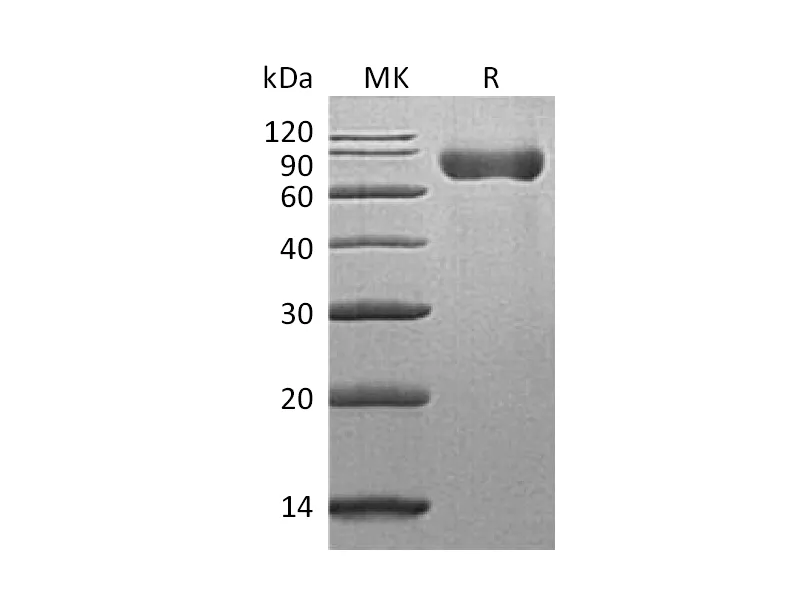
EnkiLife provides the Recombinant Mouse SLAMF3 (C-6His) protein,aslo know as T-lymphocyte surface antigen Ly-9,Cell surface molecule Ly-9,Lymphocyte antigen 9,SLAM family member 3,SLAMF3,Signaling lymphocytic activation molecule 3,CD229,Ly9,Ly-9, which features high purity, high activity, and high stability. It can be applied in scientific research, biopharmaceuticals, and other fields.Purity:Greater than 95% as determined by reducing SDS-PAGE;Endotoxin Level:<1 EU/µg as determined by LAL test.;Construction:Recombinant Mouse T-lymphocyte Surface Antigen Ly-9 is produced by our Mammalian expression system and the target gene encoding Lys48-Phe454 is expressed with a 6His tag at the C-terminus.Accession:Q4VBG4. Expression Host:Human Cells.Species:Mouse.Predicted Molecular Mass:47 KDa. Background:CD229(SLAMF3) is a type I transmembrane glycoprotein in the SLAM subgroup of the CD2 family. Mature mouse CD229 consists of a 406 aa extracellular domain (ECD) with two Ig-like V-set and two Ig-like truncated C2-set domains, a 21 aa transmembrane segment, and a 180 aa cytoplasmic domain with two immunoreceptor tyrosinebased switch motifs ITSMs. Within the first two Ig-like domains that are common to all SLAM proteins, mouse CD229 shares 22%-36% aa sequence identity with mouse 2B4, BLAME, CD2F10,CD84, CRACC, NTBA, and SLAM. CD229 is expressed on T, B, and NK cells, thymocytes and monocytes. Homophilic binding between CD229 molecules is mediated by the N-terminal Ig-like domain. Human and mouse CD229 exhibit crossspecies binding. Antigen stimulation of lymphocytes induces CD229 clustering to sites of T cell-B cell contact. Antibody ligation of CD229 can inhibit T cell activation, but CD229 knockout mice show impaired T cell immune responses, suggesting a potential role for CD229 in T cell activation or costimulation.
More from EnkiLife