
SETMAR Rabbit Polyclonal Antibody
APRab17779-50μL · 50μL
Verified Partner
Sign in to see pricing and request a quote.
Brand Store Product
No external links. Get your quote directly here.

Description
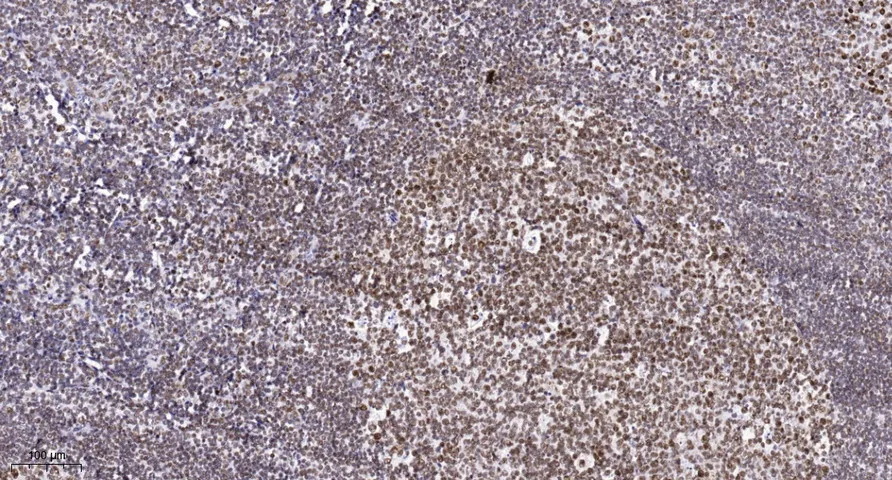
EnkiLife offers the SETMAR Rabbit Polyclonal Antibody. This antibody reacts with Human,Rat,Mouse species and is suitable for IHC,ICC/IF,ELISA application. Alternative Names of Immunogen: SETMAR; Histone-lysine N-methyltransferase SETMAR; SET domain and mariner transposase fusion gene-containing protein; HsMar1; Metnase. The product boasts remarkable high specificity, outstanding reproducibility, and exceptional affinity, making it a reliable and superior choice for your needs. Dilution Ratio: IHC 1:100-1:300,ICC/IF 1:50-1:200,ELISA 1:20000-1:40000 Background: This gene encodes a fusion protein that contains an N-terminal histone-lysine N-methyltransferase domain and a C-terminal mariner transposase domain. The encoded protein binds DNA and functions in DNA repair activities including non-homologous end joining and double strand break repair. The SET domain portion of this protein specifically methylates histone H3 lysines 4 and 36. This gene exists as a fusion gene only in anthropoid primates, other organisms lack mariner transposase domain. Alternate splicing results in multiple transcript variants. [provided by RefSeq, Jan 2013],catalytic activity:S-adenosyl-L-methionine + histone L-lysine = S-adenosyl-L-homocysteine + histone N(6)-methyl-L-lysine.,domain:The mariner transposase Hsmar1 region mediates DNA-binding. It has no transposase activity because the active site contains an Asn in position 610 instead of a Asp residue.,function:Histone methyltransferase that methylates 'Lys-4' and 'Lys-36' of histone H3, 2 specific tags for epigenetic transcriptional activation. Specifically mediates dimethylation of H3 'Lys-36'. Binds DNA. May play a role in non-homologous end-joining repair.,miscellaneous:The mariner transposase region in only present in primates and appeared 40-58 million years ago, after the insertion of a transposon downstream of a preexisting SET gene, followed by the de novo exonization of previously non-coding sequence and the creation of a new intron.,similarity:Contains 1 post-SET domain.,similarity:Contains 1 pre-SET domain.,similarity:Contains 1 SET domain.,similarity:In the C-terminal section; belongs to the mariner transposase family.,similarity:In the N-terminal section; belongs to the histone-lysine methyltransferase family.,tissue specificity:Widely expressed, with highest expression in placenta and ovary and lowest expression in skeletal muscle., Research Area: Lysine degradation;